

Many people stop and think before typing this word. Is it “comming” or “coming”? The answer is simple. Only one spelling is right, and it is “coming.” This guide explains the spelling, the meaning, and the rule behind it. You will also find many examples, tables, and quick tips to help you remember it for good.
Is It “Comming” or “Coming”?
The correct spelling is “coming.” It has one “m.” The form “comming” is a spelling mistake. It does not exist in standard English, and no dictionary lists it as a valid word.
Writers often add a second “m” by habit. They see words like “swimming” or “running” and assume the same pattern works here. It does not. The word “come” follows a different rule, which you will learn below.
If you want a fast check, use this trick. Say the word “come.” Now add “-ing” without changing the “m.” You get “coming.” Never type two m’s.
Quick examples
Here are a few short sentences that show the correct spelling in use.
- The bus is coming.
- Summer is coming soon.
- My friends are coming tonight.
- A new season is coming to the show.
Now look at this table. It shows the right and wrong forms side by side.
| Spelling | Status | Example |
| Coming | Correct | She is coming home today. |
| Comming | Incorrect | She is comming home today. |
| Comeing | Incorrect | She is comeing home today. |
What Does “Coming” Mean?
“Coming” is the present participle of the verb “come.” It describes movement toward a place or person. It can also describe something that will happen soon. You will see it in speech, writing, ads, and signs every day.
The word is simple, but it has more than one use. It can work as a verb form, an adjective, or even a noun in some cases. Knowing these uses helps you write with more confidence.
Definition
“Coming” means moving toward someone or something. It also means approaching in time or about to happen. For example, “the coming year” means the year that is about to begin.
In short, it points to something that is arriving or will arrive soon.
Pronunciation
The word is pronounced KUM-ing. The first part sounds like the word “gum.” The second part sounds like “ing” in “sing.”
Many learners mix up the vowel sound. The “o” in “coming” does not sound like the “o” in “go.” It sounds like a short “u.” This is the same sound you hear in “come,” “some,” and “love.”
Part of Speech
“Coming” can play different roles in a sentence. The table below shows the main ones.
| Part of Speech | Example |
| Verb (present participle) | He is coming to the party. |
| Adjective | The coming week looks busy. |
| Noun | The coming of spring made everyone happy. |
Common meanings
Here are the most common ways people use the word.
- Arriving: “The train is coming.”
- Approaching in time: “The coming holidays are exciting.”
- Happening soon: “A big change is coming.”
- Moving toward the speaker: “Come here” becomes “I am coming.”
- Being released: “New phone coming next month.”
Why “Comming” Is Incorrect
“Comming” is wrong because it breaks a basic spelling rule. The base word “come” ends in a silent “e.” When you add “-ing,” you drop that “e.” You do not double the “m.” So the result is “coming,” not “comming.”
There is no rule in English that supports the double “m” here. It is simply a common error. Even native speakers make it when they type fast.
Why people make this mistake
Several reasons explain why this spelling error is so common.
- Pattern confusion: Words like “swimming,” “running,” and “stopping” double the last letter.
- Sound: The short “u” sound feels like it needs a stronger consonant.
- Fast typing: The “m” key is easy to press twice.
- Similar words: “Summer,” “hammer,” and “comment” all have a double “m.”
- Lack of rule knowledge: Many people never learned the silent “e” rule.
The good news is that the fix is easy. Once you learn the rule, the mistake disappears.
Why “Coming” Has Only One “M”

The best way to understand the spelling is to build the word step by step. Start with the root. Then add the ending. Watch what happens to each letter.
This small process explains everything. It also works for many other English words.
Start with the base word
The base word is “come.” It has four letters: c, o, m, e. The last letter is a silent “e.” It is not pronounced, but it affects how the word is spelled.
Add “-ing”
Now you want to add “-ing” to show an ongoing action. The silent “e” is in the way. English usually removes it when the ending starts with a vowel. The letter “i” is a vowel, so the “e” must go.
Here is the step-by-step build:
- Start with come.
- Remove the silent e to get com.
- Add -ing to get coming.
Why the “M” Doesn’t Double
The “m” does not double because the word does not need it. Doubling happens only in short words that end in a single vowel and a single consonant. The word “come” ends in a silent “e,” not a consonant. So the doubling rule does not apply.
Think of it this way. The “e” is removed, and that is the only change. Nothing else is needed.
The English Rule Behind This Spelling
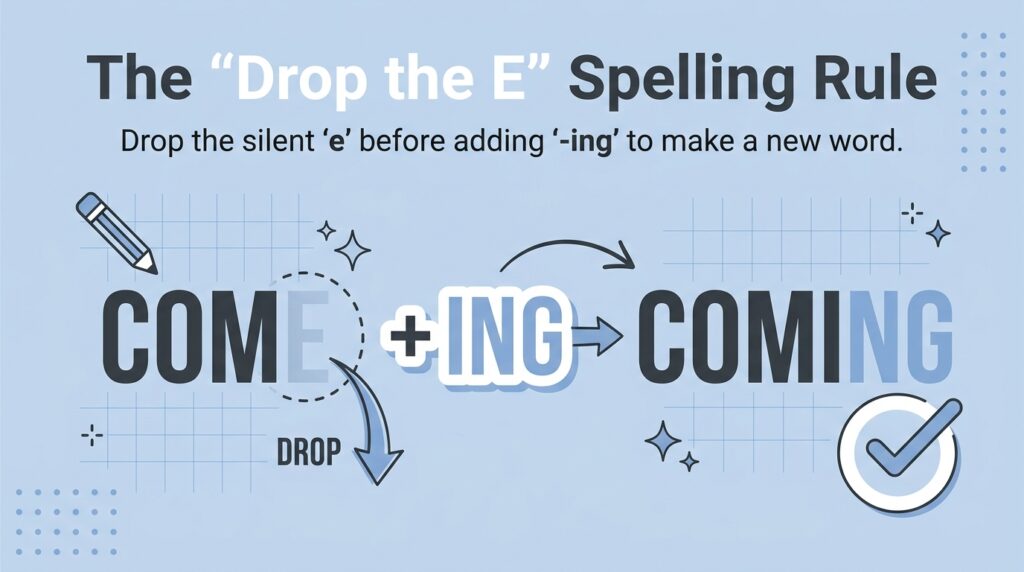
Two simple rules control this spelling. Many people mix them up. Once you see them clearly, you will never confuse them again.
Let us look at each rule one by one. Then we will see why they should not be mixed.
Rule One: Drop the Silent E Before Adding “-ing”
If a word ends in a silent “e,” drop the “e” before adding “-ing.” This rule is very common in English.
| Base Word | Add -ing |
| Come | Coming |
| Make | Making |
| Write | Writing |
| Take | Taking |
| Love | Loving |
| Have | Having |
Notice that none of these words double a consonant. They only lose the “e.”
Rule Two: Double the Final Consonant Only When Required
Some words do double the last consonant. This happens when a short word ends in one vowel followed by one consonant. The stress is on the last syllable or the word is a single syllable.
| Base Word | Add -ing |
| Run | Running |
| Swim | Swimming |
| Stop | Stopping |
| Sit | Sitting |
| Plan | Planning |
| Begin | Beginning |
These words do not end in a silent “e.” That is why they can double.
Rule Three: Don’t Mix the Two Rules
Here is where most mistakes happen. People apply the doubling rule to a word that needs the silent “e” rule. The word “come” belongs to the silent “e” group. So it should never double.
A simple test can help you:
- Does the word end in a silent “e”? Drop the “e” and add “-ing.”
- Does the word end in one vowel and one consonant? You may need to double.
- Never do both at the same time.
Examples of “Coming” in Everyday Sentences
Seeing a word in real sentences makes it easier to remember. Below are examples from different parts of life. Read them out loud. This builds a strong memory of the correct spelling.
Daily conversations
- “I am coming in five minutes.”
- “Who is coming with us?”
- “Is your cousin coming today?”
- “Good things are coming your way.”
- “She said she is coming soon.”
School
- “The exam is coming next week.”
- “The teacher is coming to the class now.”
- “New students are coming on Monday.”
- “The coming semester has more subjects.”
Workplace
- “The manager is coming to the meeting.”
- “A new project is coming this month.”
- “Are the clients coming at noon?”
- “Big changes are coming to our team.”
Family
- “My grandparents are coming for dinner.”
- “A baby is coming into our family.”
- “Mom said the guests are coming at six.”
- “My brother is coming home for the holidays.”
Travel
- “The flight is coming in late.”
- “Our tour guide is coming to the hotel.”
- “The train is coming to platform two.”
- “Are you coming with us on the trip?”
Weather
- “A storm is coming tonight.”
- “Winter is coming early this year.”
- “Dark clouds are coming from the west.”
- “The rain is coming soon.”
Technology
- “A new update is coming next week.”
- “The app is coming to Android soon.”
- “New features are coming to the platform.”
- “Messages are coming in fast.”
Common Words That Follow the Same Rule
“Coming” is not alone. Many words that end in a silent “e” lose the “e” and do not double the consonant. Learning this group helps you spell with ease.
Here is a helpful list of similar words.
| Base Word | With -ing | Common Wrong Form |
| Come | Coming | Comming |
| Make | Making | Makking |
| Take | Taking | Takking |
| Give | Giving | Givving |
| Live | Living | Livving |
| Move | Moving | Movving |
| Use | Using | Ussing |
| Care | Caring | Carring |
| Write | Writing | Writting |
A special note on “hope.” The word “hoping” means to wish. The word “hopping” means to jump. They come from different base words, “hope” and “hop.” The spelling changes the meaning.
The same is true for “write” and “writ.” Always check the base word first.
Read More: Channel vs Chanel: Meaning, Differences & Usage (2026)
Words That Do Double the Final Consonant
Some words do double the last letter. These words are short and end in a single vowel plus a single consonant. They do not end in a silent “e.”
Here are common examples.
| Base Word | With -ing |
| Run | Running |
| Swim | Swimming |
| Stop | Stopping |
| Sit | Sitting |
| Get | Getting |
| Put | Putting |
| Win | Winning |
| Cut | Cutting |
| Shop | Shopping |
| Plan | Planning |
Notice the key difference. None of these words end with an “e.” That is why they follow a different rule.
A quick memory tip:
- Silent “e” words: drop the “e.” Do not double.
- Short vowel + consonant words: double the consonant.
Coming Soon Meaning

“Coming soon” is a popular phrase. It tells people that something will be available in the near future. You see it on movie posters, shop windows, websites, and apps.
The phrase builds interest. It tells the reader to wait and watch. It does not give an exact date. It only says the wait will not be long.
Here are common places where you will see it:
- Movie and TV trailers
- New product launches
- Website pages under construction
- Restaurant and shop openings
- App and software updates
- Book and music releases
For example, a store might put a sign that says, “New store coming soon.” This tells people the store will open shortly. A website might say, “New blog posts coming soon.” This means fresh content will arrive in a short time.
Always spell it as “coming soon.” Never write “comming soon.” The wrong spelling can hurt trust, especially in business and marketing.
Comming vs Coming Grammar
From a grammar view, “coming” is the present participle of “come.” It is used to form continuous tenses. It also acts as an adjective or a noun.
“Comming” has no grammatical role. It is not a word, so it cannot serve any function in a sentence.
Here is how “coming” works in different tenses.
| Tense | Example |
| Present continuous | She is coming now. |
| Past continuous | She was coming yesterday. |
| Future continuous | She will be coming tomorrow. |
| Present perfect continuous | She has been coming daily. |
Notice that “coming” always follows a helping verb like “is,” “was,” “will be,” or “has been.” This is the normal pattern for continuous tenses.
As an adjective, it comes before a noun. For example, “the coming election” or “the coming days.”
When Did Comming Change to Coming
This question is common, but it has a small problem. “Comming” never became “coming” because “comming” was never a standard English word. It was only a spelling mistake.
The verb “come” has existed for many centuries. Over time, its forms changed in Old and Middle English. But the modern “-ing” form has long followed the silent “e” rule. Early spellings did vary, since English spelling was not fixed. But those variations are historical, not modern errors.
Today, the standard form is “coming.” Modern dictionaries, style guides, and schools all agree on this.
If you saw “comming” in an old text, it likely reflected loose spelling habits of that time. It is not a form you should use now.
Comming vs Coming Examples
Let us see both forms in clear contrast. The wrong spelling is shown only to help you spot and avoid it.
| Incorrect | Correct |
| I am comming to your house. | I am coming to your house. |
| Winter is comming soon. | Winter is coming soon. |
| Are you comming with us? | Are you coming with us? |
| The comming year looks bright. | The coming year looks bright. |
| Guests are comming at eight. | Guests are coming at eight. |
| A new movie is comming out. | A new movie is coming out. |
A good habit is to read your text out loud. If you hear a short “u” sound followed by “ming,” check your spelling. You should see only one “m.”
You can also use spell check tools. But do not rely on them fully. Learning the rule is the best long-term fix.
Correct Spelling of Comming
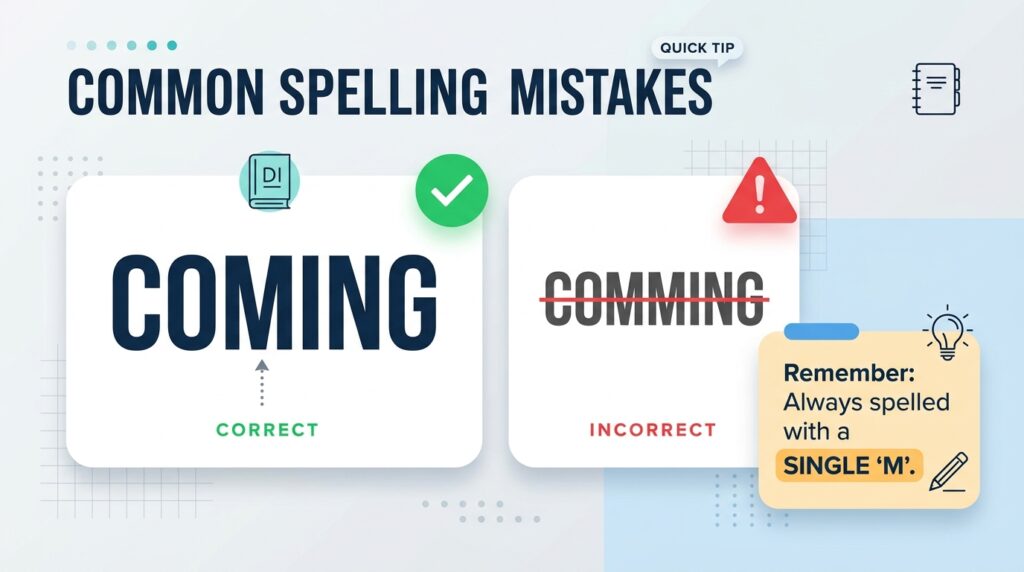
The correct spelling of “comming” is coming. Remove one “m,” and the word is right.
Many people search for this phrase when they are unsure. They want to confirm which spelling is safe. The answer is always the same. Use “coming.”
Here is a short guide to help you remember:
- Start with come.
- Drop the silent e.
- Add -ing.
- Result: coming.
You can also think of it as a small formula: come minus e plus ing equals coming.
Use this formula for similar words too. It works for “making,” “taking,” “giving,” and “living.” Once it becomes a habit, you will not need to stop and think.
Comming Meaning
“Comming” has no meaning. It is not a real English word. It is only a common misspelling of “coming.”
If someone writes “comming,” they almost always mean “coming.” That means moving toward a place, arriving, or about to happen.
Search engines often show results for “comming meaning” because many users type it that way. But the answer is clear. The correct word is “coming,” and it means approaching or arriving.
Here is a quick table to clear up any doubt.
| Word | Real Words? | Meaning |
| Coming | Yes | Arriving, approaching, or about to happen |
| Comming | No | No meaning, it is a spelling error |
Comming or Coming Soon
The correct phrase is “coming soon.” The phrase “comming soon” is a typo.
This matters a lot in business. A sign that says “comming soon” looks careless. It can lower trust in a brand. Customers may think the business does not pay attention to detail.
Here are a few good ways to use the phrase correctly:
- “New menu coming soon.”
- “Our website is coming soon.”
- “Coming soon to a theater near you.”
- “New collection coming soon.”
Always proofread banners, ads, and web pages before you publish them. One extra “m” can change how people see your work.
Comming vs Coming Meaning
When you compare the two, the difference is simple. “Coming” has a clear meaning. “Comming” has none.
Only one of them belongs in your writing. That is “coming.” It can describe movement, time, or events that are near.
Here is a quick summary:
- Coming: correct, meaningful, and widely used.
- Comming: incorrect, meaningless, and should be avoided.
If you ever feel unsure, go back to the base word. “Come” plus “-ing” gives “coming.” That is the whole answer.
Coming or Comming
“Coming or comming” is one of the most searched spelling questions. The answer is always “coming.”
You can trust this answer in emails, essays, reports, and social media posts. It is correct in American English, British English, and every other standard form.
A simple way to lock it in your memory is this rhyme: “Come loses its e, and the m stays single.”
Here is a mini checklist before you hit send:
- Did I use only one “m”?
- Did I drop the silent “e” from “come”?
- Does the word look like “coming”?
If yes, you are safe.
Comming or Coming Difference
The difference is simple. One is a real word. The other is a mistake.
| Feature | Coming | Comming |
| Spelling | Correct | Incorrect |
| Dictionary entry | Yes | No |
| Grammar use | Verb, adjective, noun | None |
| Safe for writing | Yes | No |
There is no regional difference either. Both American and British English use “coming.” No version of English accepts “comming.”
So the difference is not about style or meaning. It is only about right and wrong. Choose the right one every time.
Coming Spelling
The spelling of “coming” is C-O-M-I-N-G. It has six letters. It has only one “m.”
Say the letters slowly: C, O, M, I, N, G. This helps you see that there is no second “m.”
Here are some helpful memory tricks:
- Visual trick: Picture a single “m” like one small bridge in the middle of the word.
- Rule trick: Remember “come” loses its “e.”
- Sound trick: The sound is “KUM-ing,” not “KUM-MING.”
- Practice trick: Write the word five times by hand.
These simple tricks work well for students and adults. They also help non-native English learners.
Spelling of Coming
The spelling of “coming” is simple once you know the rule. It comes from the base word “come.” You drop the silent “e” and add “-ing.”
Here is a final recap table of the spelling steps.
| Step | Action | Result |
| 1 | Start with the base word | come |
| 2 | Drop the silent e | com |
| 3 | Add -ing | coming |
Do not add another “m.” Do not keep the “e.” The word is complete as “coming.”
If you keep this three-step process in mind, you will spell the word right every single time. It also helps you with many other words in the same group.
Frequently Asked Questions
Is it “comming” or “coming”?
The correct spelling is “coming.” The form “comming” is a common spelling mistake and is not a real English word.
Why does “coming” have only one “m”?
The word comes from “come,” which ends in a silent “e.” You drop the “e” and add “-ing,” so the “m” never doubles.
What does “coming soon” mean?
“Coming soon” means something will be available or will happen in the near future. It is often used for movies, products, and websites.
Is “comming” ever correct in English?
No. “Comming” is never correct in modern English. Dictionaries only list “coming” as the valid spelling.
How do you pronounce “coming”?
“Coming” is pronounced KUM-ing. The first syllable rhymes with “gum,” and the second sounds like “ing.”
What is the rule for adding “-ing” to words ending in silent e?
Drop the silent “e” and add “-ing.” For example, “come” becomes “coming” and “make” becomes “making.”
What is the easiest way to remember the spelling of “coming”?
Remember this formula: come, minus the e, plus ing. That gives you “coming” with a single “m.”
Final Thoughts
The correct spelling is “coming,” with one “m.” The word “comming” is a spelling mistake and has no meaning. The rule is easy. Drop the silent “e” from “come” and add “-ing.” The consonant does not double.
Once you understand this rule, you can spell many other words with confidence. Words like “making,” “taking,” and “living” follow the same pattern. Keep practicing, read your writing out loud, and always check the base word. Soon, the right spelling will feel natural.

Reyansh is a passionate English language and grammar writer who enjoys making grammar, spelling, vocabulary, and writing concepts simple and easy to understand. With a focus on clear explanations and practical examples, Reyansh creates helpful content for students, writers, and everyday English learners. His goal is to make learning English more enjoyable, useful, and accessible to everyone.