

Many people type “dought” when they mean “doubt,” because the two look and sound alike, but only “doubt” is a real English word. It means a feeling of uncertainty or a lack of belief in something, as in “I have no doubt you will succeed.” The “b” is silent, so the word is pronounced “dout,” which rhymes with “out.”
The mistake happens because we spell what we hear, and since the “b” makes no sound, it is easy to leave out or to swap in a different letter. To remember it, think of the “b” in “doubt” as a hidden letter that is there but never heard. You can also link it to related words like “redoubtable,” where the “b” is easier to spot, and practice writing the word a few times until the correct spelling feels natural.
What Does “Doubt” Mean?
“Doubt” means a feeling of not being sure. It shows that you do not fully believe something. It can also mean that you question whether something is true, real, or possible.
The word is common in daily speech. You hear it at school, at work, and at home. It works as both a noun and a verb, which makes it very flexible.
Simple Definition of Doubt
Doubt is the state of being unsure about something. You may not trust a fact, a person, or a plan. Something just feels uncertain.
Here is a quick view of the meaning:
| Part of Speech | Meaning | Short Example |
| Noun | A feeling of uncertainty | I have a doubt about this answer. |
| Verb | To feel unsure or not believe | I doubt he will come. |
Examples of Doubt in Everyday English
People use “doubt” all the time. Here are some simple lines you might say or hear:
- “I doubt it will rain today.”
- “She had no doubt about her choice.”
- “He doubts that the story is true.”
- “There is some doubt about the date.”
- “Do you doubt my words?”
Each sentence shows a small gap in belief. The speaker is not fully sure.
Doubt as a Noun
As a noun, “doubt” names the feeling. It is something you have, feel, or express. You can have a little doubt or a lot of doubt.
Think of it as a thing in your mind. You can say, “My doubt is growing.” You can also say, “There is no doubt.” In both cases, the word names a state of mind.
Examples
Here are clear examples of “doubt” used as a noun:
- “I have a doubt about this plan.”
- “Her doubt kept her from signing the form.”
- “There is little doubt that he is honest.”
- “His words left me in doubt.”
- “The doubt in her voice was easy to hear.”
Common Synonyms
Synonyms are words with a similar meaning. These can help you vary your writing.
| Synonym | Example |
| Uncertainty | There is uncertainty about the result. |
| Hesitation | He felt hesitation before speaking. |
| Skepticism | She showed skepticism toward the claim. |
| Mistrust | His mistrust grew over time. |
| Misgiving | I have a misgiving about this deal. |
Real-Life Example
Imagine a student named Sara. She studies hard for a math test. On the morning of the exam, she feels a small doubt. She wonders if she remembered the formulas.
That feeling is doubt as a noun. It is not fear. It is not panic. It is just a quiet sense of being unsure. She reviews her notes one more time, and the doubt fades.
Doubt as a Verb
As a verb, “doubt” is an action. You do it when you question or distrust something. It tells us what a person thinks or feels.
The verb form is very common in spoken English. People often say “I doubt it” as a short reply. It means “I do not think so.”
Examples
Here are simple examples of “doubt” as a verb:
- “I doubt he will arrive on time.”
- “She doubts her own skills.”
- “They doubt that the offer is real.”
- “Nobody doubted his honesty.”
- “Do you doubt the results?”
Common Sentence Structures
The verb “doubt” follows a few easy patterns. Learning them will help you write with confidence.
| Structure | Example |
| Doubt + that + clause | I doubt that she knows the answer. |
| Doubt + whether + clause | He doubts whether the plan will work. |
| Doubt + noun | They doubt his story. |
| Do not doubt + noun | Never doubt your strength. |
| I doubt it / I doubt so | “Will it snow?” “I doubt it.” |
Is “Dought” a Real Word?
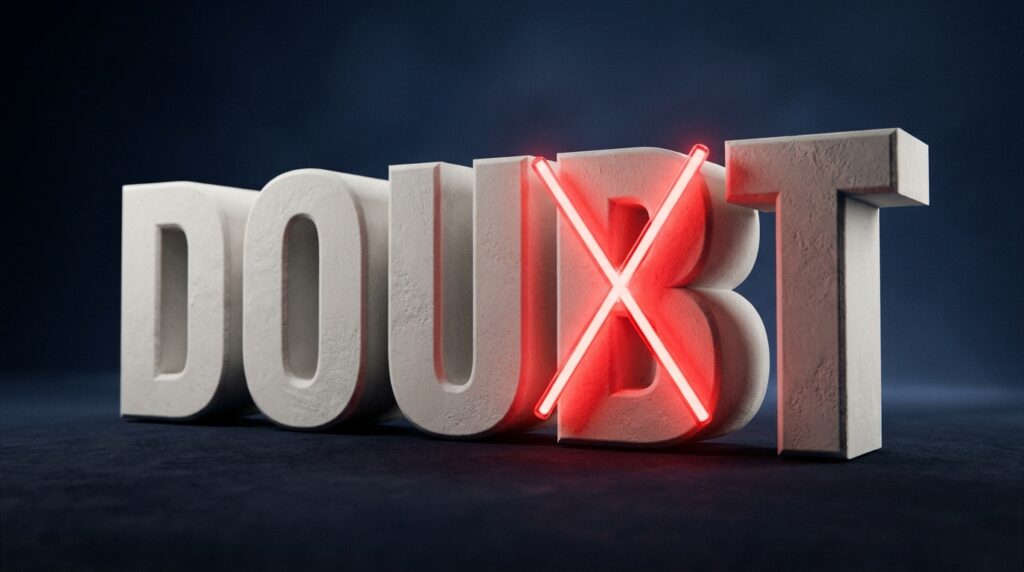
No. “Dought” is not a real word in modern English. You will not find it in any standard dictionary as a correct spelling of “doubt.” It is a common spelling error.
You may sometimes see “dought” in old texts or as a rare variant. But in today’s writing, it is simply wrong. If you mean the word that talks about uncertainty, always write “doubt.”
Search engines show that many people look up “dought meaning” and “is dought a word.” This shows how common the confusion is. The simple answer is that “dought” has no standard meaning and should be avoided.
Why People Write “Dought” Instead of “Doubt”
The main reason is sound. When we say “doubt,” we say “dowt.” The “b” makes no sound. So the brain hears “d-ow-t” and tries to match it with letters.
The letters “ou” in English often make the “ow” sound. Think of “out,” “house,” and “mouth.” So it feels natural to write “dout” or “dought.” The silent “b” is easy to forget because you never hear it.
Another cause is the “ought” pattern. Words like “thought,” “bought,” and “fought” all end in “ought.” Because of this, some people add “gh” or “ght” by habit. The result is “dought,” which looks like a real word but is not.
Other Reasons for the Mistake
Sound is not the only cause. Several other things lead to this error:
- Fast typing: People type quickly and skip a letter or swap letters.
- Phone autocorrect gaps: Some apps do not fix the word.
- Learning by listening: People who learn English by ear do not see the spelling.
- Non-native speakers: English spelling rules feel very uneven to new learners.
- Pattern guessing: The brain wants every word to follow a pattern.
These reasons are normal. Making this mistake does not mean you are bad at English. It just means the word is tricky.
Historical Background of the Word “Doubt”
The word “doubt” has a long history. It came into English from Old French, where it was written as “douter.” That word came from Latin “dubitare,” which meant “to waver” or “to hesitate.”
In early English, people spelled it “dout” or “doute.” There was no “b.” Later, scholars wanted English words to look more like their Latin roots. So they added the “b” back to match “dubitare.”
The sound did not change, but the spelling did. This is why we now have a silent “b.” It is a leftover from a spelling choice made hundreds of years ago. Many English words went through the same change.
| Stage | Form | Language |
| Ancient | dubitare | Latin |
| Middle | douter | Old French |
| Early | dout / doute | Middle English |
| Modern | doubt | English |
Dought vs Doubt: Side-by-Side Comparison

A direct comparison makes the difference easy to see. Only one of these words is correct.
| Feature | Dought | Doubt |
| Is it a real word? | No | Yes |
| Correct spelling? | Incorrect | Correct |
| Part of speech | None | Noun and verb |
| Meaning | No standard meaning | Uncertainty or disbelief |
| Silent letter | Not applicable | Silent “b” |
| Use in writing | Avoid | Use freely |
| Pronunciation | Not defined | /daʊt/ |
Here is the rule in one line. If you mean “not sure,” write “doubt.” Never write “dought.”
Why Silent Letters Cause So Much Confusion
English has many silent letters. They are letters you write but do not say. Some examples are the “k” in “knife,” the “w” in “write,” and the “b” in “doubt.”
Silent letters confuse people for one big reason. The spelling does not match the sound. Your ears tell you one thing. Your eyes see another. This creates a gap that is hard to bridge.
Here are common silent letter pairs that cause trouble:
- Silent b: doubt, debt, comb, climb, thumb
- Silent k: knee, know, knock, knight
- Silent w: write, wrong, answer, sword
- Silent g: gnat, sign, design
- Silent h: hour, honest, heir
Many of these silent letters come from older forms of the language. Over time, the pronunciation changed. The spelling stayed the same. That is why English often feels unfair to learners.
How to Pronounce “Doubt” Correctly

Good pronunciation helps you remember the spelling. It also helps others understand you. The word “doubt” is short and easy once you know the trick.
Correct Pronunciation
“Doubt” is pronounced “dowt.” It rhymes with “out,” “shout,” and “about.” The IPA symbol is /daʊt/.
Break it into two sounds:
- D: a soft tap of the tongue
- OWT: the same sound as in “out”
Say it slowly: “d” + “out.” Then say it faster: “doubt.” That is all there is to it.
Important Tip
Do not say the “b.” Never say “dow-bt” or “doub-t.” The “b” has no sound at all. If you pronounce it, the word will sound odd to native speakers.
Many people who search “how to pronounce dought” or “dought vs doubt pronunciation” are really asking this question. The answer is the same for both: say “dowt.”
Remember the Silent B Family
Memory tricks make spelling easier. Try these simple ideas to remember the “b” in “doubt.”
Use a Visual Association
“Doubt” and “debt” share the same silent “b.” Both words come from Latin roots with a “b.” Group them together in your mind. When you write one, think of the other.
Here is a small family of silent “b” words:
| Word | Pronunciation | Meaning |
| Doubt | dowt | Uncertainty |
| Debt | det | Money owed |
| Subtle | suh-tl | Not obvious |
| Climb | klyme | To go up |
| Thumb | thum | A finger |
Create a Phrase
A short phrase can lock the spelling in your head. Try this one:
“Without a doubt, the B is hiding out.”
Another option is “Do you doubt? Then don’t leave the B out.” Pick any line you like. Say it a few times. The silly sound makes it stick.
You can also remember that “doubt” has the word “out” inside it, with a “d” and “b” at the ends. Think “D-ou-b-t.” Spell it letter by letter a few times.
See More : Grately vs Greatly: Correct Spelling & Meaning (2026)
Common Examples of Doubt in Sentences
Seeing a word in real sentences helps you learn faster. Below are examples from different settings. Use them as a guide for your own writing.
Everyday Conversation Examples
- “I doubt we will make it on time.”
- “There is no doubt she loves music.”
- “Do you doubt what I said?”
- “I have a small doubt about this recipe.”
- “He never doubted his friend.”
- “Without a doubt, this is my favorite place.”
Workplace Examples
- “I have no doubt that the team can finish the project.”
- “There is some doubt about the budget.”
- “Please tell me if you have any doubt about the plan.”
- “The manager doubted the numbers in the report.”
- “We removed all doubt by checking the data twice.”
Academic Examples
- “The study leaves little doubt about the link.”
- “Researchers doubt that the method is accurate.”
- “The results raise doubt about the earlier theory.”
- “Students should question ideas, but not doubt without reason.”
- “The evidence is beyond doubt.”
Popular Idioms and Phrases With “Doubt”
Idioms are fixed phrases with special meanings. “Doubt” appears in many of them. Learning these will make your English sound more natural.
Without a Doubt
This means “for sure” or “certainly.” It is a strong way to show you are confident.
Example: “She is, without a doubt, the best singer in the group.”
Benefit of the Doubt
This means to trust someone even when you are not fully sure. You assume they are honest or right.
Example: “I will give him the benefit of the doubt this time.”
In Doubt
This means “unsure” or “not certain.” It is often used for plans, facts, or results.
Example: “If you are in doubt, ask your teacher.”
Beyond Doubt
This means “completely certain.” There is no room for questions.
Example: “The proof was beyond doubt.”
No Doubt About It
This is a casual way to say “I agree” or “that is clearly true.”
Example: “It was a great game, no doubt about it.”
| Idiom | Meaning |
| Without a doubt | Certainly |
| Benefit of the doubt | Trust without proof |
| In doubt | Not sure |
| Beyond doubt | Fully certain |
| No doubt about it | Clearly true |
Grammar Rules for Using Doubt Correctly
“Doubt” follows a few simple grammar rules. Learn them once, and you can use the word with ease.
Doubt That
Use “doubt that” in a statement when you feel something is unlikely. It is common in both formal and casual English.
- “I doubt that he will call.”
- “She doubts that the shop is open.”
Doubt Whether
“Doubt whether” is also correct. It is a little more formal. “If” can replace “whether” in casual speech.
- “I doubt whether the plan will work.”
- “He doubts if the train is on time.”
Negative Usage
With negative sentences, the meaning changes. “I do not doubt that he is right” means “I am sure he is right.” Here, “that” is the usual choice.
- “I do not doubt that she is honest.”
- “There is no doubt that the plan works.”
Be careful with double negatives. Writing “I don’t have no doubt” is not correct in standard English. Say “I have no doubt” or “I don’t have any doubt.”
| Pattern | Example |
| Positive doubt | I doubt that it is true. |
| Negative doubt | I do not doubt that it is true. |
| No doubt | There is no doubt about it. |
| Wrong double negative | I have no doubt. (Avoid) |
Words Commonly Confused With Doubt
“Doubt” has close cousins. They share a similar feeling but are not the same. Here is how to tell them apart.
Doubt vs Suspicion

Doubt means you are unsure if something is true. Suspicion means you think something wrong may be happening. Suspicion usually involves a bad guess about someone’s actions.
- “I doubt his story.” (I am not sure it is true.)
- “I suspect he lied.” (I think he lied.)
Doubt vs Uncertainty
These two are very close. “Uncertainty” is a wider word. It covers any lack of certainty, such as about the weather or the future. “Doubt” often points to a specific claim or person.
- “There is uncertainty about next year.”
- “I have doubt about this claim.”
Doubt vs Fear
Doubt is about belief. Fear is about danger or harm. You can doubt without being afraid. You can fear without doubting.
- “I doubt the bridge is safe.” (Not sure.)
- “I fear the bridge will fall.” (Worried about harm.)
| Word | Core Idea | Example |
| Doubt | Not sure it is true | I doubt it will work. |
| Suspicion | Thinks something is wrong | I suspect he cheated. |
| Uncertainty | General lack of certainty | The future is uncertain. |
| Fear | Worry about harm | I fear the storm. |
How Doubt Affects Communication
Doubt shapes how we speak and write. It changes our tone. It can make us sound careful, polite, or unsure. Words like “maybe,” “I think,” and “I doubt” all signal uncertainty.
In conversation, small doubts keep us honest. We admit what we do not know. This builds trust. But too much doubt can make a message weak. People may feel you lack confidence.
Strong Communication Balances Doubt
Good communicators mix confidence with honesty. They state facts clearly. They also admit gaps when needed. This balance makes them sound reliable.
Try these tips:
- State what you know with clear words.
- Use “I doubt” only when you truly are unsure.
- Avoid too many hedge words like “maybe” and “perhaps.”
- Back up your points with facts.
Example in Business
Picture a manager giving a sales report. She says, “I have no doubt that sales will grow, but I doubt we can hit the full target by March.” This is balanced. She shows confidence and honesty in one line.
Now compare it to: “Maybe sales could possibly grow, I guess.” That sounds weak. The team may not trust the plan. Clear language builds stronger business communication.
The Psychology Behind Doubt
Doubt is a normal human feeling. Everyone feels it at some point. Psychologists see it as part of how we think and make choices. It makes us stop and check before we act.
The mind uses doubt as a warning light. It says, “Wait. Check this first.” This can protect us from mistakes. But the same feeling can also hold us back if it grows too strong.
Positive Effects of Doubt
Healthy doubt can be helpful. It pushes us to think deeper and ask better questions.
- Better decisions: We compare options before choosing.
- Learning: Questions lead to new knowledge.
- Safety: We avoid scams and false claims.
- Science: Researchers test ideas instead of trusting them blindly.
- Humility: We accept that we can be wrong.
Negative Effects of Excessive Doubt
Too much doubt can cause problems. It can freeze action and lower confidence.
- Self-doubt: You stop believing in your own skills.
- Overthinking: You cannot make simple choices.
- Missed chances: Fear of failure stops you from trying.
- Stress: Constant worry affects mood and sleep.
- Weak relationships: You may struggle to trust others.
If doubt feels heavy and lasts a long time, talking with a trusted person or a counselor can help.
| Type of Doubt | Effect |
| Healthy doubt | Better thinking and safer choices |
| Excessive doubt | Stress, delay, and low confidence |
Doubt in Literature and Famous Quotes
Writers have explored doubt for centuries. It appears in stories, poems, and speeches. It often drives a character to grow or change.
A well-known example is Shakespeare’s Hamlet. The prince spends the whole play unsure about what to do. His doubt shapes the entire story. It shows how heavy uncertainty can feel.
Many thinkers have also shared ideas about doubt. In general, they say that doubt is a path to truth. A person who questions ideas often learns more than one who accepts everything. This view is common in science and philosophy.
Doubt also appears in religious and moral writing. It is often seen as a test of belief. Some traditions treat it as a step toward stronger faith. Others see it as a sign of honest thinking.
Common themes in books and quotes about doubt include:
- Doubt leads to wisdom.
- Doubt can block action.
- Faith and doubt often live side by side.
- Questioning is part of growth.
Common Mistakes People Make With “Doubt”
Even strong writers slip up with this word. Here are the most common errors and how to fix them.
Misspelling It as “Dought”
This is the top mistake. The correct form is “doubt.” Always include the “b” and use “ou,” not “ough.”
- Wrong: “I dought it will work.”
- Right: “I doubt it will work.”
Pronouncing the B
Some learners say the “b” out loud. This makes the word sound like “dow-bt.” The “b” is silent. Say “dowt.”
Using Double Negatives Incorrectly
Avoid stacking negatives. Phrases like “I don’t have no doubt” are not standard English.
- Wrong: “I don’t have any doubt.”
- Right: “I have no doubt.”
Confusing It With Similar Words
Some people mix “doubt” with “dout,” “doubtful,” or “dowt.” Others confuse it with “suspect.” Check the meaning before you choose.
| Mistake | Correction |
| dought | doubt |
| dout | doubt |
| doub’t | doubt |
| Saying “dow-bt” | Say “dowt” |
| I don’t have no doubt | I have no doubt |
Quick Memory Chart for Dought vs Doubt
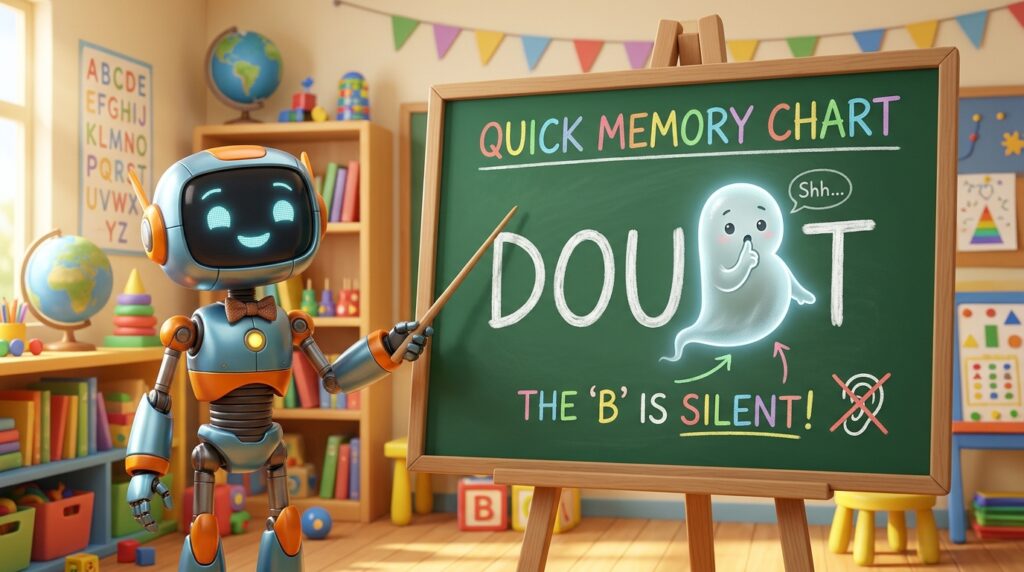
Use this chart as a fast reminder. Save it or screenshot it for later.
| Tip | How It Helps |
| Spelling: D-O-U-B-T | Five letters, with a silent “b” |
| Sound: “dowt” | Rhymes with “out” |
| Memory phrase | “Without a doubt, the B is hiding out.” |
| Word family | Doubt, debt, subtle, climb, thumb |
| Rule | “Dought” is always wrong |
| Check | Look for the “b” before you hit send |
Why Correct Spelling Matters in Writing
Spelling is the first thing readers notice. A small error can change how people see you. Correct spelling shows care and skill. It also helps readers focus on your message instead of your mistakes.
Good spelling matters in school, in business, and online. It affects grades, jobs, and even search results.
Professional Consequences
At work, spelling errors can hurt your image. A typo in an email may seem small. But it can make you look careless. In a resume or a report, it can cost you trust.
Clients and managers often judge quality by details. If you spell “doubt” wrong in a proposal, they may doubt your attention to detail. That is a risk you can easily avoid.
SEO Impact
For websites, spelling affects visibility. Search engines read your text. Misspelled words can lower content quality in the eyes of readers. Visitors may leave your page quickly if they see errors.
Still, people do search for “dough” because they make the same mistake. A smart writer can include helpful content that explains the correct spelling. That way, the page helps both groups. Always use the correct spelling in your main copy, and address the misspelling only to guide readers.
How Teachers and Editors View “Dought”
Teachers and editors treat “dought” as a spelling error. They will mark it wrong and ask for a fix. It does not matter if the meaning is clear. The spelling still counts.
Editors look for clean, error-free text. A repeated mistake can make them question the whole piece. That is why a simple word like “doubt” matters so much.
Academic Standards
In schools and universities, spelling is part of the grade. Many rubrics include language accuracy. A student who writes “dought” may lose marks.
Here is what academic standards usually expect:
- Correct spelling of common words
- Proper grammar and punctuation
- Clear and consistent style
- Proofreading before submission
Even a strong idea can lose force when spelling is weak. Take a moment to check every paper.
Real-World Case Study: How One Letter Changes Credibility
Let us look at a simple example. Two people apply for the same job. Both have similar skills. The only difference is one small spelling choice.
Resume A
Resume A says: “I have no doubt that my skills fit this role.”
The hiring manager sees the error right away. She wonders if the candidate checks his work. The message of confidence is weakened by the typo.
Resume B
Resume B says: “I have no doubt that my skills fit this role.”
The sentence is clean and strong. The manager moves on to the next detail without any distraction. The candidate looks careful and professional.
| Feature | Resume A | Resume B |
| Spelling | dought | doubt |
| First impression | Careless | Professional |
| Message strength | Weakened | Strong |
| Likely outcome | Lower trust | Higher trust |
One missing letter changed how the reader felt. This is why proofreading is so valuable.
Best Ways to Avoid Spelling Mistakes Like “Dought”
Good spelling is a skill you can build. These simple habits will help you avoid errors like “dought.”
Read More Frequently
Reading shows you how words look on the page. The more you see “doubt,” the more natural it feels. Read books, articles, and news in English each day. Even ten minutes helps.
Use Spell Check Tools
Spell checkers catch many errors. Turn on autocorrect on your phone and computer. Use tools like Grammarly or built-in editors in Word and Google Docs. They will flag “dough” right away.
Do not rely only on tools. They can miss context. Always read your text once yourself.
Slow Down While Typing
Many errors come from speed. Take a breath before you send an email or post. Read the message aloud. Your eyes and ears will catch things that fast typing misses.
Learn Word Families
Group words that share the same pattern. Study “doubt,” “debt,” “subtle,” and “climb” together. This builds a strong memory link for the silent “b.”
Here is a simple habit plan:
- Keep a small notebook of tricky words.
- Write each word three times.
- Use it in a sentence of your own.
- Review the list once a week.
Related Words Derived From Doubt
Once you know “doubt,” you can use many related words. They share the same root and the same silent “b.”
| Word | Part of Speech | Example |
| Doubtful | Adjective | It is doubtful that he will come. |
| Doubtfully | Adverb | She looked at him doubtfully. |
| Doubter | Noun | The doubter asked many questions. |
| Doubtless | Adjective/Adverb | He is doubtless the best choice. |
| Doubtlessly | Adverb | She doubtlessly knows the answer. |
| Undoubted | Adjective | His talent is undoubted. |
| Undoubtedly | Adverb | This is undoubtedly a good idea. |
| Self-doubt | Noun | Self-doubt can hold you back. |
| Redoubt | Noun | The soldiers hid in the redoubt. |
Notice that all of them keep the “b.” This is a good clue. If a word is from this family, the “b” stays.
Why English Spelling Feels So Inconsistent
English has a mixed history. It borrowed words from Latin, French, German, and many other languages. Each source brought its own spelling style. Over time, pronunciation changed, but spelling often stayed old.
This is why “doubt” has a silent “b.” It is also why “through,” “though,” and “tough” look alike but sound different. There is no single clean rule.
Here are the main reasons for the mess:
- Borrowed words: English took words from many languages.
- Sound shifts: Pronunciation changed over the centuries.
- Printing press: Early printers fixed spellings that did not fully match speech.
- Scholar choices: Writers added letters to show Latin roots, as with “doubt.”
The good news is that patterns do exist. Learning word families and common exceptions makes spelling easier. With practice, tricky words like “doubt” become second nature.
Frequently Asked Questions
Is “dough” ever correct?
No. “Dought” is not a correct spelling in modern English. The right word is “doubt,” with a silent “b.”
Why is the “b” silent in “doubt”?
The “b” was added by scholars in the past to match the Latin root “dubitare.” The pronunciation stayed the same, so the “b” has no sound.
How do you pronounce “doubt”?
Say “dowt.” It rhymes with “out” and “shout.” Do not pronounce the “b.”
Is “without a doubt” grammatically correct?
Yes. “Without a doubt” is a correct and common phrase. It means “certainly” or “for sure.”
What does self-doubt mean?
Self-doubt means a lack of trust in your own abilities or choices. It is the feeling that you may not be good enough.
What is the difference between “dought” and “doubt”?
“Doubt” is a real word that means uncertainty. “Dought” is only a common spelling mistake with no standard meaning.
How can I remember the spelling of “doubt”?
Link it with “debt,” which also has a silent “b.” You can also use the phrase “Without a doubt, the B is hiding out.”
Final Thoughts
“Dought” is not a real word. The correct spelling is “doubt,” with a silent “b.” It means a feeling of being unsure, and it works as both a noun and a verb. Say it as “dowt,” and remember its word family: doubt, debt, subtle, and climb.
A small spelling choice can shape how others see you. Clean writing builds trust at school, at work, and online. Use the memory tricks in this guide, read often, and proofread your text. Soon, “doubt” will feel easy and natural.

Reyansh is a passionate English language and grammar writer who enjoys making grammar, spelling, vocabulary, and writing concepts simple and easy to understand. With a focus on clear explanations and practical examples, Reyansh creates helpful content for students, writers, and everyday English learners. His goal is to make learning English more enjoyable, useful, and accessible to everyone.