

Many writers stop and wonder about this pair of words. Should it be “shute” or “chute”? The two look alike. They sound the same. But only one of them is a common English word.
This guide clears up the confusion. You will learn what each word means, where it comes from, and how to use it correctly. You will also find memory tricks, real examples, and a quick chart you can save for later.
Shute vs Chute: The Quick Answer
“Chute” is the correct spelling for the everyday word. It means a sloping channel, passage, or slide. Things drop, slide, or travel down it. Think of a trash chute, a water slide, or a parachute.
“Shute” is not a standard English word. You will only see it as a surname or a place name. For example, Nevil Shute was a famous author. So if you are writing about a slide, a drop, or a channel, use “chute.”
Here is the simple rule. If you mean a sloping passage, write “chute.” If you mean a person’s last name or a specific place, “Shute” may be right. Everything else is a spelling error.
Shute vs Chute Comparison Table
This table shows the main differences at a glance.
| Feature | Chute | Shute |
| Is it a standard word? | Yes | No |
| Part of speech | Noun (also used as a verb) | Proper noun only |
| Basic meaning | A sloping channel or passage | A surname or place name |
| Pronunciation | /ʃuːt/ (rhymes with “boot”) | Same sound as “chute” |
| Capital letter needed? | No, unless it starts a sentence | Yes, always |
| Found in dictionaries? | Yes | Only as a name entry, if at all |
| Example | The laundry chute is stuck. | Nevil Shute wrote novels. |
The big takeaway is simple. The two words sound identical, but they do not share the same job. One is a common noun. The other is a name.
What Does Chute Mean?

A chute is a tool or structure that helps things move downward. It can be built from metal, wood, plastic, or concrete. It can be tiny or very large. What matters is the slope. Gravity does the work.
You see chutes in homes, farms, factories, parks, and airplanes. The word is also used in everyday speech. People talk about a “chute” in a casual way, even when they mean something small.
Definition of Chute
A chute is a narrow, sloping channel. It lets people, objects, or materials slide or fall from a higher place to a lower one. The word can also describe a steep slide in a water park or a short form of “parachute.”
Here is a simple way to think about it. A chute is a guided drop. It keeps the item on a set path. That path makes the move safe, fast, and tidy.
The word also works as a verb. You can chute grain into a bin, for example. This use is less common, but it is still correct.
Pronunciation of Chute
“Chute” is pronounced “shoot.” It rhymes with “boot,” “root,” and “fruit.” The “ch” at the start sounds like “sh.” This comes from French, which we will cover later.
Here is a quick pronunciation guide:
- Sound: /ʃuːt/
- Simple spelling: shoot
- Rhymes with: boot, suit, route
- Syllables: one
Many English learners expect “ch” to sound like the start of “chair.” That is why the spelling feels odd. In this word, “ch” makes a soft “sh” sound.
Common Uses of Chute
People use “chute” in many settings. Some uses are physical. Others are more figurative.
- Home use: a laundry chute or trash chute
- Sports and fun: a water chute at a park
- Farming: a chute that guides cattle or grain
- Industry: a conveyor chute that moves goods
- Aviation: a parachute or an escape chute on a plane
- Rodeo: the gate area where an animal waits before a ride
Each use shares the same core idea. Something moves down a guided path.
Types of Chutes Found in Everyday Life
You may not notice chutes, but they are everywhere. Here are the most common kinds.
| Type of Chute | Where You See It | What It Does |
| Trash chute | Apartment buildings | Drops garbage to a bin below |
| Mail chute | Office buildings | Sends letters down to a lobby box |
| Water chute | Parks and pools | Gives riders a wet slide |
| Loading chute | Farms and docks | Helps load animals or goods |
| Cattle chute | Ranches | Holds livestock for care |
Trash Chute
A trash chute is a vertical tube inside a tall building. Residents drop bagged waste into a small door on their floor. The garbage falls to a large bin in the basement.
This saves time. No one has to carry bags down many floors. It also keeps hallways cleaner. Buildings with many floors often use this system.
Mail Chute
A mail chute runs down the side of a building. People drop letters into a slot on any floor. The mail slides down to a collection box in the lobby.
Older office towers and hotels often have them. The glass design lets you see the letters travel. Some of these chutes are now historic features.
Water Chute
A water chute is a ride found at water parks and fairs. Riders sit in a boat or on a mat. They slide down a steep, wet track and splash into a pool.
The word “water chute” is common in British English. In American English, people often say “water slide.” Both mean a similar ride.
Loading Chute
A loading chute helps move goods or animals onto a truck or trailer. It is usually a ramp with side walls. The walls keep the load from straying.
Farmers use loading chutes every day. So do warehouse workers. The design makes loading faster and safer for everyone.
Livestock or Cattle Chute
A cattle chute is a narrow pen that holds one animal at a time. Ranchers use it for vaccines, health checks, and tagging. The animal stays calm and in place.
This tool protects both the animal and the worker. Without it, treating large cattle would be risky. It is a key part of any working ranch.
Example Sentences Using Chute
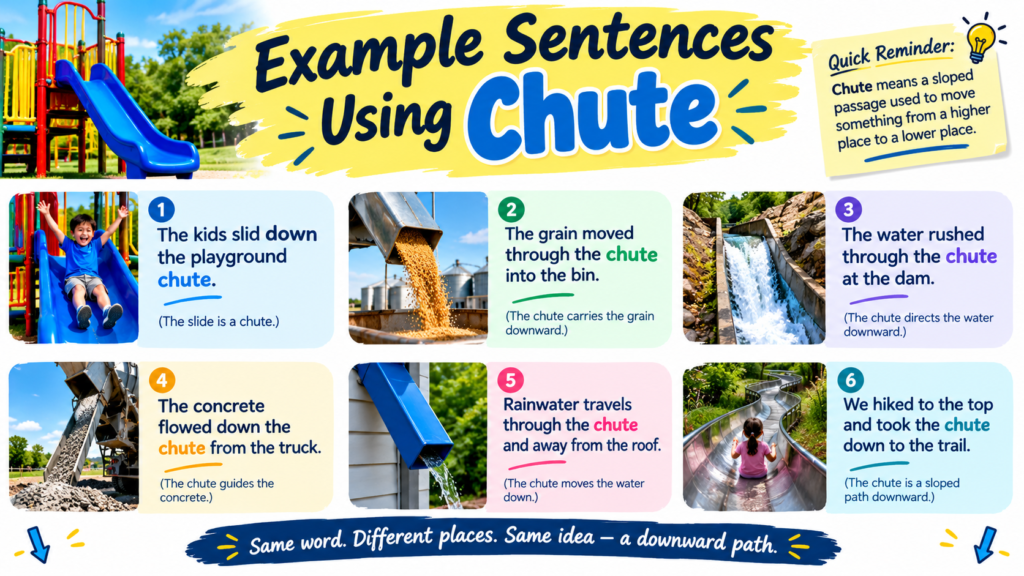
Examples make a word easier to learn. Here are sentences for different settings.
Everyday Examples
- She dropped the laundry down the chute.
- The kids screamed with joy on the water chute.
- Please put all rubbish in the trash chute, not on the floor.
- He pulled the cord, and his chute opened wide.
- The mail slid down the chute and landed in the box.
Professional Examples
- The plant manager repaired the conveyor chute before the shift began.
- Workers cleared a jam in the grain chute at the mill.
- The vet checked each cow in the cattle chute.
- Engineers tested the new escape chute on the aircraft.
- The warehouse added a loading chute to speed up deliveries.
Educational Examples
- A teacher might say, “Chute rhymes with boot, not with church.”
- The science class built a paper chute to test how fast marbles roll.
- In a spelling quiz, the right answer is “chute,” not “shute.”
- The student wrote a short report about how a parachute works.
- The book explained that “chute” comes from a French word.
Is Shute a Real Word?
Not as a common word. You will not find “shute” in standard English dictionaries as a noun for a slide or channel. If you type it to mean a sloping passage, it is a spelling mistake.
That said, “Shute” does exist in two special cases. It is a surname, and it is a place name. In both cases, it must start with a capital letter. Let us look at each.
Shute as a Surname
Shute is a real family name, mostly found in England. One famous bearer was Nevil Shute, the British author. He wrote A Town Like Alice and On the Beach.
Other people carry this name too. In these cases, it is correct to write “Shute.” The name has nothing to do with slides or drops. It is simply how the family name is spelled.
Here is a good test. If the word names a person, use “Shute.” If it names a thing that slides, use “chute.”
Shute as a Place Name
“Shute” also appears in the names of places. There are villages and areas in England with this name. Shute in Devon is one example. You may also find streets or small spots named Shute.
Place names often keep old spellings. They do not follow modern rules. So a place can be called Shute, even though the common word is “chute.”
Remember to use a capital letter for these. A place name is a proper noun. A slide or passage is not.
Why Most People Mean Chute
When someone types “shute” in daily writing, they almost always mean “chute.” Very few of us write about a person named Shute or a place with that name. Most of the time, we are talking about a slide, a drop, or a parachute.
So here is a safe rule. Unless you are naming a person or place, pick “chute.” You will be right nearly every time.
See More : Emersion vs. Immersion: Meaning, Differences & Examples 2026
The Origin and History of Chute
Words carry a story. The story of “chute” explains why its spelling looks so odd. It also shows why people mix it up.
French Origins
“Chute” comes from the French word chute. In French, it means “a fall.” That word came from the Old French cheoite, which grew out of the Latin verb cadere, meaning “to fall.”
So the root idea has always been falling. That makes sense. A chute is a path for things that fall or slide down. The meaning stayed close to the original.
Evolution Into English
English borrowed the word in the 1700s. At first, it was used for rapids or a steep part of a river. People used it to describe water that dropped quickly.
Over time, the meaning grew. Writers used it for any steep, sloping channel. The word kept its French spelling. That is why “ch” sounds like “sh” in this word. French “ch” makes that soft sound.
Historical Development
The word’s meaning kept expanding as technology changed. Here is a simple timeline.
| Period | How the Word Was Used |
| 1700s | Rapids or a steep fall in a river |
| 1800s | Mining chutes, logging chutes, and grain chutes |
| Late 1800s | Short form of “parachute” |
| 1900s | Trash chutes, mail chutes, and amusement rides |
| Today | Used in homes, farms, sports, and travel |
The word has grown with every new invention. That is why it fits so many settings now.
Why People Confuse Shute and Chute
The mix-up is easy to understand. Several small reasons add up. Knowing them can help you avoid the error.
Similar Pronunciation
Both words sound the same. When you say them aloud, there is no difference. If you only hear a word and never see it, you may guess the spelling.
Our brains often spell by sound. That works for many words. It fails for words like “chute,” where the spelling follows an older, French pattern.
English Sound Patterns
English has many spelling patterns. Most “ch” words sound like “chair” or “church.” Only a few borrowed words, like “chef” and “machine,” use the soft “sh” sound.
Because of this, learners can feel torn. The “sh” sound points to “sh” spelling. The word’s actual spelling follows French. That clash causes errors.
Typing Habits
Fast typing can lead to slips. Writers who type by sound may choose “sh” without thinking. Texting and quick notes make this more likely.
People also copy what they have seen. If you see “shute” in a post, you may think it is correct. Habits spread this way.
Visual Similarity
The two words look almost alike. Only the first two letters differ. Your eye can skip over “ch” and “sh” when reading fast.
This is why proofreading matters. A small letter swap is easy to miss. Reading slowly helps you catch it.
Shute vs Chute: Side-by-Side Examples
Seeing wrong and right forms together makes the lesson stick. Here are clear examples.
Incorrect Usage
These sentences use the wrong spelling.
- The kids loved the water shute.
- He threw the bag down the trash shute.
- Her shute opened just in time.
- The cattle shute was full.
- Put the mail in the shute on the third floor.
Each sentence refers to a slide or channel. So “shute” is wrong in all of them.
Correct Usage
Here are the same sentences, fixed.
- The kids loved the water chute.
- He threw the bag down the trash chute.
- Her chute opened just in time.
- The cattle chute was full.
- Put the mail in the chute on the third floor.
And here are two correct uses of “Shute” as a name.
- Nevil Shute was a British novelist.
- We visited the village of Shute in Devon.
| Wrong | Right | Reason |
| water shute | water chute | Slide, not a name |
| trash shute | trash chute | Common noun |
| Mr. Chute wrote the book (for Nevil Shute) | Mr. Shute wrote the book | Name spelled differently |
Common Words Related to Chute
Some words contain “chute” or share the same idea. Learning them can lock in the spelling.
Parachute
A parachute is a large fabric canopy. It slows a person’s fall through the air. The word joins “para,” meaning “protect against,” with “chute,” meaning “fall.”
So a parachute literally protects you from a fall. Notice the spelling. It ends in “chute,” not “shute.” This is the best clue to remember.
Water Chute
A water chute is a wet ride at a park. It is also a term used in boating and engineering for a channel that carries water. In both cases, the water moves downward along a set path.
Conveyor Chute
A conveyor chute guides items from a conveyor belt to another place. Factories, mines, and shipping centers use them. The chute stops items from spilling and keeps the line moving.
Other related terms include:
- Escape chute: an emergency slide on a plane
- Laundry chute: a tube for sending clothes downstairs
- Coal chute: a channel used to move coal
- Chute-the-chute: an old-fashioned amusement ride
Grammar Tips to Remember the Correct Spelling
Good memory tricks beat long rules. Try these four simple ideas.
Memory Trick #1: Think of Parachute
You already know how to spell “parachute.” It has “chute” at the end. Link the two words in your mind. If you can write “parachute,” you can write “chute.”
Say it to yourself: “A parachute has a chute.”
Memory Trick #2: Connect It to Channels
Both “chute” and “channel” start with “ch.” A chute is a type of channel. Things move through it. Use this link to recall the “ch” start.
Think: “Chute and channel both begin with CH.”
Memory Trick #3: Remember Construction Signs
Many construction and farm sites use the word “chute” on signs. Examples include “Debris Chute” and “Loading Chute.” Picture a bright yellow sign. The “ch” spelling is on it.
This image can help you recall the right form when you write.
Memory Trick #4: Associate It With Falling
A chute is built for falling or sliding. The word “fall” is also the root of “chute” in French. Picture something dropping down. Then picture the “ch” spelling beside it.
Here is a quick comparison of the tricks.
| Trick | Core Idea | Best For |
| Parachute | Same ending | Quick recall |
| Channels | Same “ch” start | Visual thinkers |
| Construction signs | Real-world images | Practical learners |
| Falling | Meaning link | Word-history fans |
Common Mistakes Writers Make
Even careful writers slip on this word. Here are the top errors and how to avoid them.
Mistake: Using Shute Everywhere
Some writers use “shute” for every case. They think it is just another spelling. It is not. Outside of names, it is wrong.
Fix: Use “chute” for all slides, drops, and channels.
Mistake: Confusing Proper Nouns With Common Nouns
Another error is spelling a person’s name as “Chute” when it is “Shute.” The reverse also happens. Names do not follow the same rules as everyday words.
Fix: Check the person’s actual name. If you are unsure, look up the author or the place. Names should match their official spelling.
Mistake: Relying Solely on Pronunciation
Since both words sound alike, some people trust their ears. This works for easy words. It fails here.
Fix: When a word sounds the same as another, check the spelling. A quick look at a dictionary is enough.
Mistake: Trusting Autocorrect Completely
Autocorrect can help, but it is not perfect. It may leave “shute” alone if it thinks it is a name. It may also change its real name to “chute.”
Fix: Read your text once more after typing. Do not rely on software alone.
Real-World Case Study: The Cost of a Simple Spelling Error
Here is a short story that shows why spelling matters.
A small outdoor adventure company wanted to promote a new water ride. The marketing team printed 5,000 flyers. Big letters across the top said, “Try Our New Water Shute!” No one caught the error before printing.
Customers noticed right away. Some posted jokes online. Others questioned the quality of the business. A few even said, “If they cannot spell their own ride, can we trust their safety?” The company had to reprint all the flyers. It lost both money and time.
This example shows a simple truth. A tiny spelling slip can hurt your image. People link good spelling with good care. A quick proofread would have saved the cost.
The lesson is clear:
- Always proofread public material.
- Ask a second person to check it.
- Keep a short list of tricky words handy.
Quick Reference Chart
Save this chart for fast checks.
| Situation | Correct Word | Example |
| Sloping slide or channel | Chute | The trash chute is on level two. |
| Parachute short form | Chute | His chute opened at 3,000 feet. |
| Water ride | Chute | We rode the water chute twice. |
| Livestock tool | Chute | The vet used the cattle chute. |
| Surname | Shute | Nevil Shute wrote many novels. |
| Place name | Shute | Shute is a village in Devon. |
| Any other use | Chute | Use “chute” by default. |
Frequently Asked Questions
Is it shute or chute?
“Chute” is the correct spelling for a sloping channel or slide. “Shute” is only used as a surname or place name.
What does chute mean?
A chute is a sloping passage that lets people or things slide or fall to a lower place. Trash chutes and water slides are common examples.
How do you pronounce chute?
Chute is pronounced “shoot.” It rhymes with “boot” and “fruit.”
Is shute a real word?
Not as a common word. It exists only as a surname, like Nevil Shute, or as a place name, like Shute in Devon.
Where does the word chute come from?
It comes from the French word chute, meaning “a fall.” That word traces back to the Latin verb cadere, which means “to fall.”
Is parachute spelled with chute or shute?
Parachute ends in “chute.” It joins “para,” meaning “protect against,” with “chute,” meaning “fall.”
Why do people spell chute as shute?
Both words sound the same, so people spell by ear. The “ch” with a “sh” sound is rare in English, which adds to the confusion.
Final Thoughts
“Chute” is the word you want in almost every case. It means a sloping path where things slide or fall. It comes from French, and its spelling follows that history. Trash chutes, water chutes, cattle chutes, and parachutes all use this form.
“Shute” is only for names. Use it for a person’s surname or a place, and always capitalize it. If you are unsure, remember the parachute trick. Then proofread once more before you publish. A small check keeps your writing clear and trusted.

Reyansh is a passionate English language and grammar writer who enjoys making grammar, spelling, vocabulary, and writing concepts simple and easy to understand. With a focus on clear explanations and practical examples, Reyansh creates helpful content for students, writers, and everyday English learners. His goal is to make learning English more enjoyable, useful, and accessible to everyone.