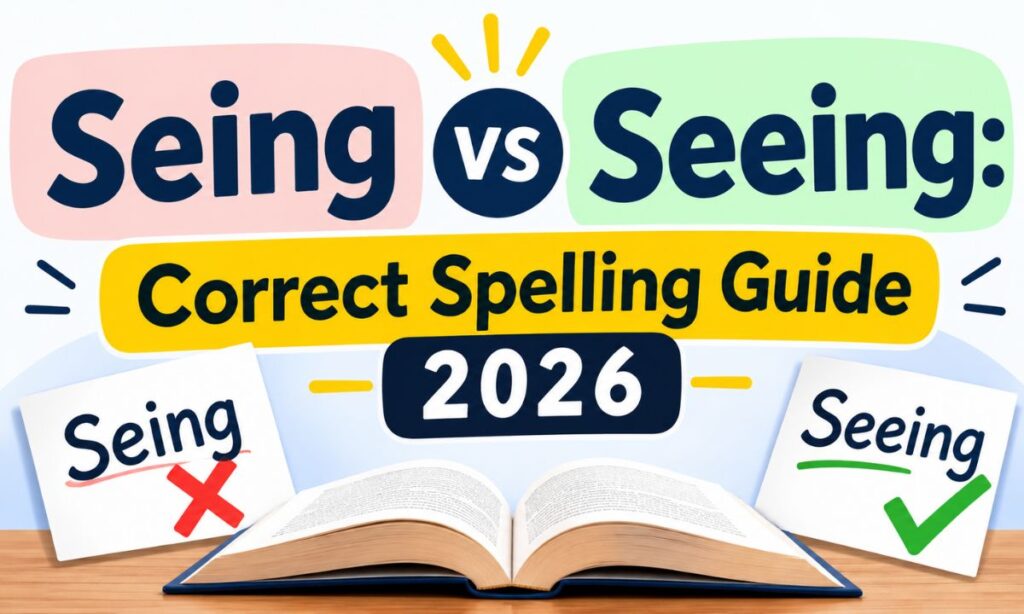
“Seeing” is the only correct spelling, while “seing” is just a common typo and not a real English word. People mix them up because they assume the “-ing” form drops an “e,” the way “make” becomes “making.” But “see” has no silent “e” to drop, so you simply add “-ing” to get “seeing.”
An easy way to remember it is to picture the two “e”s as a pair of eyes: s-e-e-i-n-g. The same rule applies to related words like “foreseeing” and “overseeing,” so once you know it, you can spell the whole family of words with confidence in 2026.
Is “Seing” a Real Word?

No, “seing” is not a real English word. You will not find it in any standard dictionary. It is a misspelling of “seeing.”
The verb “see” ends in a double “e.” When you add “-ing,” you keep both letters. That gives you “seeing.” Dropping one “e” breaks the word.
Why People Confuse “Seing” and “Seeing”
Most people know the right spelling. The mistake usually comes from habit, speed, or tool use. Here are the main reasons it happens.
Fast Typing Habits
When you type fast, your fingers skip letters. Double letters are easy to miss. The “ee” in “seeing” often becomes a single “e” without you noticing.
English Grammar Rules Feel Inconsistent
Many English verbs lose a silent “e” before “-ing.” For example, “make” becomes “making.” People apply this rule to “see” by mistake. But “see” has no silent “e” to drop. Both letters are sounded, so both stay.
Pronunciation Confusion
We say “seeing” as “SEE-ing.” The long “ee” sound is one smooth sound. Because we hear one sound, some writers type only one “e.” The ear does not show the double letter.
Autocorrect Dependency
Many people rely on autocorrect. It fixes most typos, so they stop checking their spelling. When autocorrect fails or is turned off, “seing” slips through.
Similar Words That Follow the Same Grammar Rule
Several verbs with a double “e” keep both letters when you add “-ing.” Use this list to build the habit.
| Base Verb | Correct “-ing” Form | Common Typo |
| see | seeing | seing |
| agree | agreeing | agreing |
| free | freeing | freing |
| flee | fleeing | fleing |
| guarantee | guaranteeing | guaranteing |
| foresee | foreseeing | foreseing |
| disagree | disagreeing | disagreing |
The pattern is simple. If the verb ends in “ee,” keep both letters.
Seing vs Seeing: Side-by-Side Comparison
This table shows the difference at a glance.
| Feature | Seing | Seeing |
| Is it a word? | No | Yes |
| Spelling status | Incorrect | Correct |
| Part of speech | None | Verb form, gerund, participle |
| Found in dictionaries | No | Yes |
| Safe for formal writing | No | Yes |
| Example | I am seing it. (wrong) | I am seeing it. (right) |
Use “seeing” every time. There is no situation where “seing” is right.
How Native English Speakers Use “Seeing”
Native speakers use “seeing” in everyday talk, writing, and work. It is one of the most common verb forms in English. It fits many situations, from casual chats to formal reports.
Common Daily Examples
Here are simple sentences that show how “seeing” works in real life.
- I am seeing my doctor on Monday.
- She is seeing a movie tonight.
- Are you seeing the same problem?
- We are seeing great results this month.
- He enjoys seeing old friends.
- Seeing the sunrise was amazing.
Notice how natural each sentence sounds. The word always has two “e” letters.
Popular Idioms and Expressions With “Seeing”
English has many sayings that use “seeing.” Learning them helps you spell the word correctly and sound more fluent.
Seeing Is Believing
This idiom means you trust something only after you see it yourself. For example, “I doubted the new phone’s camera, but seeing is believing.”
See More : Tapping vs Taping
Seeing Eye to Eye

This phrase means two people agree. For example, “My manager and I are finally seeing eye to eye on the plan.”
Seeing Red
This means being very angry. For example, “He was seeing red after the rude comment.”
Seeing the Light
This means finally understanding something or changing your mind. For example, “After long talks, she started seeing the light.”
Seeing as a Gerund
A gerund is a verb that works like a noun. “Seeing” can act as the subject or object of a sentence.
Examples:
- Seeing new places makes me happy.
- I love seeing my family on weekends.
- Her hobby is seeing live music.
In each case, “seeing” names an activity. It does not describe a person or action in progress.
Seeing as a Present Participle
A present participle shows an action that is happening now. It often follows a form of “to be.”
Examples:
- I am seeing a rainbow.
- They were seeing signs of progress.
- She is seeing a specialist this week.
You can also use it to describe something. For example, “Seeing the storm, we went home early.” Here it explains why we acted.
Common Spelling Mistakes Similar to “Seing”
“Seing” is not the only slip people make. Many writers drop or add letters in similar words. Watch for these common errors.
| Correct Word | Common Mistake |
| seeing | seing |
| agreeing | agreing |
| being | beeing |
| receiving | recieving |
| believing | beleiving |
| writing | writting |
| running | runing |
Spotting the pattern helps. Most errors come from missing doubles or swapped letters.
Why English Spelling Confuses Learners
English spelling is not fully phonetic. Many words are not spelled the way they sound. Learners must memorize patterns instead.
English also borrows words from other languages. That adds odd spellings. Add silent letters and double letters, and mistakes are easy to make. Do not feel bad if you struggle. Even native speakers get confused.
Remember the Root Word
The best trick is simple. Start with the root word “see.” It has two “e” letters. When you add “-ing,” you do not remove anything. You just add the ending.
See + ing = seeing.
If you always begin with the root, you will not drop a letter. This one habit prevents the error.
Visual Memory Trick
Picture the word “seeing” with two eyes in the middle. The double “ee” looks like a pair of eyes. That matches the meaning of the word, since you use your eyes to see.
Write it once with the “ee” highlighted. Your brain will link the shape to the meaning. This makes the correct spelling stick.
Read It Out Loud
Reading aloud helps you catch errors. Say each word slowly and clearly. Break it into parts: “see” and “ing.”
When you hear two clear parts, you remember the root is whole. This slows your brain and helps you spot a missing letter.
Compare With Similar Words
Place “seeing” next to words you already spell right. Compare it with “being,” “freeing,” and “agreeing.” If you know those, you know the rule.
Try this small test:
- If you can spell “freeing,” you can spell “seeing.”
- If you can spell “agreeing,” you can spell “seeing.”
Matching patterns builds confidence fast.
Seeing in Academic Writing
In school and research, spelling matters. A typo can lower your grade and hurt your credibility. Always use “seeing” in essays, reports, and papers.
Academic writers often use it in phrases like “seeing that,” “seeing as,” and “seeing how.” Example: “Seeing that the data was clear, the team reached a firm conclusion.” Proofread your final draft to catch any slip.
Seeing in Business Communication
In business, clear writing builds trust. A spelling mistake in an email or report can look careless. Clients notice small errors.
Incorrect
- “We are seing strong growth this quarter.”
- “Thank you for seing me today.”
Correct
- “We are seeing strong growth this quarter.”
- “Thank you for seeing me today.”
Always review emails before you send them. A quick check protects your professional image.
Seeing in Social Media and Casual Writing
On social media, people type fast and use slang. Typos are common and often ignored. Still, correct spelling makes your posts look polished.
If you run a brand page or a blog, accuracy matters more. Followers may judge your content by small details. Use “seeing” in captions, comments, and posts so your writing stays clean.
How Search Engines Handle “Seing”
Search engines are smart. When you type “seing,” they usually show results for “seeing.” They also may show a “Did you mean” suggestion.
This is helpful for readers, but it does not help writers. If you publish content with “seing,” you may look less trustworthy. Search engines also prefer well-written pages. Correct spelling supports better quality signals for your site.
Real-World Example of the Mistake
Imagine two job candidates who send similar emails. One makes a small spelling error. The other does not. Here is how it may play out.
Candidate One
Candidate One writes: “I look forward to seing you at the interview.” The recruiter notices the typo. It makes the message look rushed. The recruiter may wonder about attention to detail.
Candidate Two
Candidate Two writes: “I look forward to seeing you at the interview.” The message is clean and clear. The recruiter feels more confident. Small details can shape first impressions.
Quick Grammar Checklist for “Seeing”
Use this short checklist before you publish or send any text.
Use “Seeing” When:
- You mean the act of viewing or noticing something.
- You mean meeting someone, such as a doctor or friend.
- You mean understanding or realizing an idea.
- You describe an ongoing action with “am,” “is,” or “are.”
- You use phrases like “seeing as” or “seeing that.”
Avoid “Seing” Because:
- It is not a real English word.
- It breaks the rule of keeping the double “e.”
- It can make your writing look careless.
- It may cause spell checkers to flag your text.
Helpful Writing Habits to Prevent Spelling Errors

Good habits beat quick fixes. Build these routines and your spelling will improve for good.
Slow Down While Typing
Speed causes mistakes. Type at a steady pace. Pay attention to double letters. A calm rhythm helps you avoid slips.
Proofread Backward
Read your text from the last word to the first. This breaks the flow of meaning. Your eyes then focus on each word and catch spelling errors.
Use Multiple Grammar Tools
Do not trust only one checker. Use two or three tools to compare results. Each tool catches different errors. Still, read the text yourself as a final step.
Read More Professionally Written Content
Reading builds visual memory. When you read books, news, and guides, you see correct spelling often. Over time, the right form feels natural.
The Psychology Behind Spelling Mistakes
Spelling mistakes are normal. The brain reads by shape, not letter by letter. That is why you can read a sentence with errors and still understand it.
This also means you often miss your own typos. Your brain fills in the gaps and shows you the correct word. Fatigue, stress, and rushing make it worse. Taking short breaks and rereading later helps you spot hidden errors.
Common Sentences Using “Seeing”
Here are more examples you can copy as models. They show different uses of the word.
| Sentence | Use |
| I am seeing improvement every day. | Present participle |
| Seeing her smile made my day. | Gerund |
| Seeing as it is late, let us stop. | Conjunction phrase |
| We are seeing the manager at noon. | Meeting someone |
| Are you seeing what I mean? | Understanding |
| Seeing is believing. | Idiom |
Practice these until they feel natural.
Seing or Seeing
The right choice is “seeing.” If you ever wonder between “seing” or “seeing,” pick “seeing.” The shorter form is always a typo. Remember the root “see” and keep both “e” letters.
Seeing or Seing
“Seeing or seing” is a question many people search online. The answer never changes. “Seeing” is correct, and “seing” is wrong. Use the longer, double “e” form in every sentence.
Seing or Seeing
Some writers search “seing or seeing” when they doubt their spelling. A fast rule helps: if the base word is “see,” the ending is “seeing.” No letter gets removed. Check your word against this rule each time.
Seeing in Tagalog

In Tagalog, “seeing” is often translated as “nakikita” or “pagkakita.” For example, “I am seeing the sea” can be “Nakikita ko ang dagat.” The word “pagkakita” is used when talking about the act of seeing, such as “Masaya ako sa pagkakita sa iyo,” meaning “I am happy about seeing you.” The best translation depends on the sentence.
Seen vs Saw Examples
“See” has three main forms. They are see, saw, and seen. Here is how they differ.
| Form | Use | Example |
| see | Present | I see the bird. |
| saw | Simple past | I saw the bird yesterday. |
| seen | Past participle | I have seen the bird before. |
Key rules:
- Use “saw” alone for a finished past action.
- Use “seen” with helper words like “have,” “has,” or “had.”
- Never say “I have seen” or “I saw it.”
More examples:
- I saw her at the mall.
- Have you seen my keys?
- He had seen the film twice.
- We saw a lovely sunset.
I Am Seeing You Meaning
“I am seeing you” can have a few meanings. It depends on the context. Here are the common ones.
- You can see someone right now. Example: “I am seeing you clearly on the video call.”
- You are dating someone. Example: “I am seeing you, and I like it.”
- You plan to meet them. Example: “I am seeing you at 5 p.m.”
Tone and setting make the meaning clear. In casual talk, the dating meaning is also common.
Seeing You Meaning
“Seeing you” usually means looking at or meeting a person. It can be a happy phrase. For example, “Seeing you makes me smile.”
It can also be part of a goodbye. Many people say “Seeing you soon” or “Looking forward to seeing you.” In these cases, it shows excitement about a future meeting.
Seeing Meaning
“Seeing” is the “-ing” form of “see.” It has several meanings.
- Viewing with the eyes: “I am seeing a bright star.”
- Understanding: “I am seeing your point.”
- Meeting or visiting: “She is seeing her lawyer.”
- Dating: “He is seeing someone new.”
- Considering a fact: “Seeing that it rained, we stayed in.”
The meaning depends on the sentence. The spelling never changes.
Frequently Asked Questions
Is “seing” a correct word in English?
No. “Seing” is not a real word. The correct spelling is “seeing.”
Why is “seeing” spelled with two e’s?
The root verb “see” already has two “e” letters. Adding “-ing” does not remove either one.
What is the difference between seing and seeing?
“Seing” is a misspelling and has no meaning. “Seeing” is the correct present participle and gerund of “see.”
What does “seeing someone” mean?
It usually means dating someone. It can also mean meeting a person, such as a doctor.
Is it “seen” or “saw”?
Use “saw” for a simple past action. Use “seen” with “have,” “has,” or “had.”
What does “seeing is believing” mean?
It means you trust something only after you see it with your own eyes.
How do you say “seeing” in Tagalog?
It is often “nakikita” or “pagkakita,” depending on the sentence.
Final Thoughts
“Seeing” is the only correct spelling. “Seing” is a simple typo caused by fast typing, autocorrect, and the way we hear the word. Keep both “e” letters when you add “-ing” to “see.”
Use the tricks from this guide to stay accurate. Start with the root word, read aloud, and proofread slowly. With small habits, you will write “seeing” correctly every time.

Reyansh is a passionate English language and grammar writer who enjoys making grammar, spelling, vocabulary, and writing concepts simple and easy to understand. With a focus on clear explanations and practical examples, Reyansh creates helpful content for students, writers, and everyday English learners. His goal is to make learning English more enjoyable, useful, and accessible to everyone.