
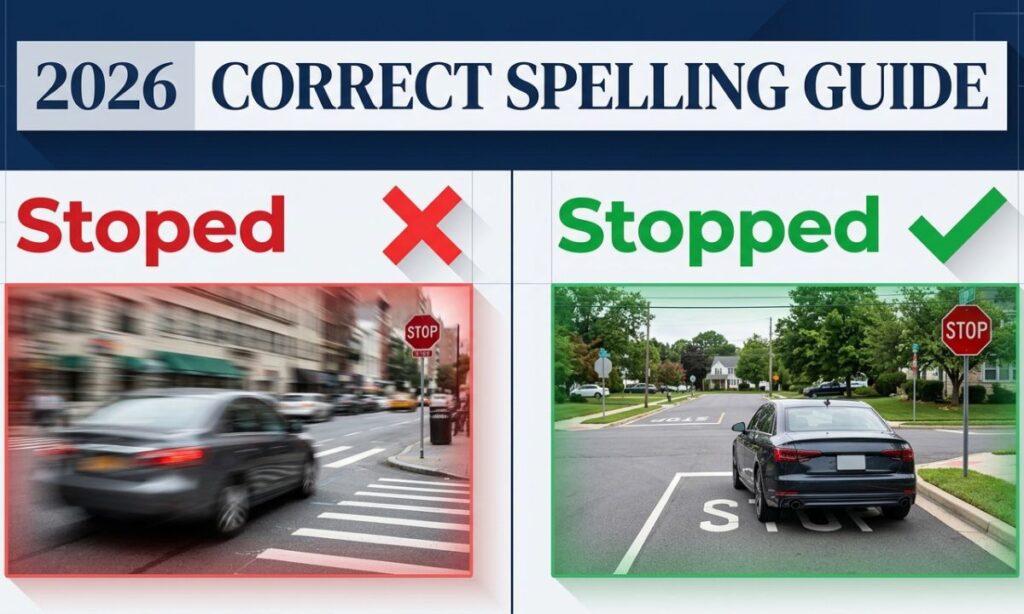
“Stopped” is the correct spelling. “Stoped” is wrong. The word is the past tense of “stop,” and it needs a double P. Many people drop one P by mistake. This guide explains the rule, the reasons behind the error, and easy ways to get it right every time.
If you have ever paused while typing this word, you are not alone. English spelling has many odd rules. This one, however, is simple once you see the pattern.
What Does “Stopped” Mean?
“Stopped” describes something that ended, paused, or did not continue. It tells us that an action or movement came to an end in the past. It can also describe something that someone blocked or prevented.
The word works as a verb and sometimes as an adjective. Both uses are common in daily English.
Simple Definition
“Stopped” is the past tense and past participle of the verb “stop.” It means to end movement, halt an action, or prevent something from going on.
Here is a quick view of its forms:
| Form | Word |
| Base form | stop |
| Third person | stops |
| Past tense | stopped |
| Past participle | stopped |
| Present participle | stopping |
Common Uses of “Stopped”
People use “stopped” in many situations. It fits casual talk, work emails, news, and school writing.
- Movement: The bus stopped at the corner.
- Actions: She stopped talking when he walked in.
- Machines: The clock stopped at midnight.
- Prevention: The guard stopped him at the gate.
- Habits: He stopped eating sugar last year.
Why People Write “Stoped”
People write “stopped” because it looks logical. The word sounds like it has only one P. The “stop” part ends in a single P, so adding “ed” seems easy.
Fast typing also plays a role. Some people skip a letter without noticing. Others simply forget the doubling rule. The result is a spelling that looks close but is still wrong.
Why “Stopped” Has Double P
The double P is not random. It follows a clear English spelling rule. When you add “ed” or “ing” to certain short words, you repeat the last letter.
This keeps the vowel sound short. Without the extra letter, the word could be read the wrong way.
Consonant-Vowel-Consonant Rule
The rule is often called the CVC rule. CVC stands for consonant, vowel, consonant. Look at the word “stop.” It ends in the letters T, O, P.
The last three letters are a consonant (T), a vowel (O), and a consonant (P). That is a CVC pattern. When a short word has this pattern, we double the last consonant before adding “ed.”
The Grammar Rule Behind “Stopped”
The full rule says this: if a one-syllable word ends in one vowel followed by one consonant, double the consonant before adding a suffix that starts with a vowel. The suffixes “ed” and “ing” both start with a vowel sound.
“Stop” fits all parts of the rule. So we get “stopped” and “stopping.”
Why Doubling Matters
Doubling is not just a formality. It protects the sound of the word. A single consonant after a vowel often signals a long vowel sound in English.
Compare these pairs:
| Single consonant | Double consonant |
| hoped (long O) | hopped (short O) |
| taped (long A) | tapped (short A) |
| coped (long O) | copped (short O) |
If we wrote “stopped,” it might look like it rhymes with “hoped.” That is not how we say the word. The double P keeps the O short.
When to Double the Final Consonant
Not every word needs a double letter. You must check three things before you double. If all three are true, you double the last consonant.
The Word Has One Syllable
Short words are the main group that follows this rule. A syllable is one beat of sound. “Stop” has one beat, so it qualifies.
Other one-syllable examples include “plan,” “drop,” and “grab.” Each one doubles its last letter when you add “ed.”
The Word Ends in Consonant-Vowel-Consonant
The ending must be a single consonant, then a single vowel, then a single consonant. The pattern must be exact.
Words with two vowels together, like “rain,” do not match. Words with two consonants at the end, like “jump,” do not match either.
The Stress Falls on the Final Syllable
For longer words, the stress matters. If the last syllable is stressed, you double the consonant. For one-syllable words, the stress is always on that single syllable, so this part is automatic.
Take “begin.” The stress falls on “gin,” so we write “beginning.” Take “prefer.” The stress falls on “fer,” so we write “preferred.”
Examples of Similar Words
Many common words follow the same pattern as “stop.”
- plan → planned
- drop → dropped
- shop → shopped
- hug → hugged
- skip → skipped
- chat → chatted
- grab → grabbed
- trap → trapped
- clap → clapped
- slip → slipped
Words That Do NOT Double the Final Consonant
Some words look similar but do not follow the doubling rule. Learning these cases will help you avoid mistakes. It also shows why “stopped” is a special case of a clear pattern.
Cases Where Doubling Does NOT Happen
Doubling does not happen if the word fails any of the three checks. Here are the common exceptions:
- The word has two vowels before the last consonant.
- The word ends in two consonants.
- The word has more than one syllable and the stress is not on the last one.
- The word ends in W, X, or Y.
Long Vowel Sounds
Words with long vowel sounds usually have two vowels or a silent E. These words do not double.
| Word | Past tense | Why no doubling |
| rain | rained | Two vowels (AI) |
| boil | boiled | Two vowels (OI) |
| hope | hoped | Silent E, just add D |
| bake | baked | Silent E, just add D |
| fix | fixed | Ends in X |
| play | played | Ends in Y |
Two-Syllable Words Without Final Stress
When a two-syllable word has stress on the first syllable, we do not double the last letter.
- visit → visited
- open → opened
- listen → listened
- offer → offered
- happen → happened
Compare these with “admit,” which has stress on the last syllable. We write “admitted” with a double T.
Stopped vs Stoped: Side-by-Side Comparison
Here is a clear look at both spellings. Only one is correct.
| Feature | Stopped | Stoped |
| Correct spelling | Yes | No |
| Double P | Yes | No |
| Found in dictionaries | Yes | No |
| Accepted in formal writing | Yes | No |
| Flagged by spell check | No | Yes |
| Vowel sound | Short O | Looks like long O |
Always choose “stopped.” There is no situation where “stopped” is right. It is not a British spelling or a rare variant. It is simply a typo.
How “Stopped” Is Used in Everyday English

“Stopped” appears in almost every type of writing. You will see it in chats, emails, reports, and essays. Learning how it works in each setting makes it easier to remember.
Everyday Conversation Examples
In daily talk, “stopped” is short and clear. People use it to describe quick events and habits.
Examples
- The rain stopped an hour ago.
- I stopped by the store on my way home.
- He stopped using his old phone.
- The kids stopped crying after a snack.
- My car stopped on the highway.
- She stopped me to ask for directions.
- We stopped for coffee after the meeting.
Professional Writing Examples
In business writing, “stopped” is used for updates, reports, and problem descriptions. The tone is usually direct and neutral.
Correct Business Usage
- The vendor stopped shipping orders last week.
- Our team stopped the campaign after low results.
- The server stopped responding at 3 p.m.
- The company stopped hiring in the third quarter.
- Payments stopped after the account was closed.
Using the right spelling in a work email builds trust. A small typo can make a message look careless.
Academic Examples
In school and research writing, “stopped” describes events, results, and changes. Accuracy is important here, so correct spelling matters even more.
Correct Academic Usage
- The experiment stopped when the temperature reached 100 degrees.
- The reaction stopped after the catalyst was removed.
- The empire stopped expanding in the second century.
- Participants stopped the task when they felt tired.
- The study stopped collecting data in May.
Why People Misspell “Stopped”
Misspellings usually have simple causes. Knowing them helps you spot your own habits. Most errors fall into three groups.
Fast Typing and Autocorrect Dependence
Many people type quickly on phones and laptops. When you type fast, small letters get skipped. A missing P is easy to miss.
Some people also rely on autocorrect too much. They stop checking their words. When autocorrect fails or is turned off, the mistake stays.
English as a Second Language Challenges
English spelling does not always match its sound. Learners often spell words the way they hear them. That leads to “stopped.”
Many other languages have more regular spelling rules. English has many exceptions, so learners need extra practice with patterns like CVC.
Pronunciation Confusion
We say “stopped” as “stopt.” The final sound is a T sound, not a D sound. This can confuse writers. They may not hear the double P at all.
The sound of the word gives no clue about the doubled letter. Only the rule explains it.
Common Grammar Mistakes Similar to “Stoped”
“Stoped” is not the only word people get wrong. Many past tense forms follow the same doubling rule. Writers often forget it in other words too.
Frequently Misspelled Words
| Wrong spelling | Correct spelling |
| planed (for plan) | planned |
| droped | dropped |
| shoped | shopped |
| huged | hugged |
| skiped | skipped |
| begining | beginning |
| occured | occurred |
| refered | referred |
| admited | admitted |
| swiming | swimming |
Each of these errors comes from the same cause. The writer forgets to double the last letter.
See More : Meating vs Meeting: Correct Spelling Guide 2026
American English vs British English Differences

Spelling often differs between American and British English. Some words use different endings or double letters in different ways.
For “stopped,” there is no difference. Both American and British English use the double P. The spelling is the same worldwide.
Stopped
Here is how the word compares across regions:
| Region | Spelling |
| United States | stopped |
| United Kingdom | stopped |
| Canada | stopped |
| Australia | stopped |
| India | stopped |
Some words do differ. For example, Americans write “traveled” while the British write “travelled.” But “stopped” stays the same everywhere. So you never need to worry about regional rules for this word.
Why Correct Spelling Matters More Than You Think
Spelling is more than a school skill. It shapes how others see you. It also affects how your writing performs online.
Spelling Affects Search Rankings
Search engines read your content to understand it. Spelling errors can make that harder. A page full of typos may look low in quality.
Correct spelling also helps people find you. If you write “stopped” correctly, your content matches what people search for. Clean writing supports trust and better results over time.
Correct Spelling Improves Readability
Readers notice errors. Even one wrong letter can pull attention away from your message. It can make the writer seem rushed.
Clear spelling keeps the reader focused. It also makes your work look professional. This matters in emails, resumes, blog posts, and school papers.
Easy Tricks to Remember “Stopped”
You do not need to memorize long rules. A few simple tricks can lock the spelling in your mind. Try the ones that work best for you.
Think About the Short Vowel Sound
The O in “stop” is short. To keep it short, the P must be doubled. A single P would suggest a long O.
Say it to yourself: short O needs double P.
Compare
Compare “stopped” with “hopped” and “hoped.” The words look alike but mean different things.
- hopped = jumped (short O, double P)
- hoped = wished (long O, single P)
If you know “hopped,” you can remember “stopped.”
Remember the CVC Pattern
Think of “stop” as a CVC word. Say “consonant, vowel, consonant” in your head. Then double the last letter before “ed.”
Quick Examples
Keep a short list of similar words in mind:
- stop → stopped
- hop → hopped
- drop → dropped
- shop → shopped
- flip → flipped
Read the Word Out Loud
Say the word slowly. Break it into parts: “stop” and “ped.” You can feel the extra P in the middle. Then write it the same way.
You can also type it three times. Muscle memory helps a lot.
Real-World Case Study: Why One Letter Matters
Imagine a small online shop owner. She wrote a product update: “Our shipping stopped last week.” A customer sees it and wonders if the shop is reliable. The message is clear, but the typo hurts her image.
Now picture the same sentence written correctly: “Our shipping stopped last week.” It looks careful and professional. The meaning has not changed, but the trust level has.
This shows why small details matter. One missing letter will not ruin a message. But it can quietly lower how people judge your work. Over time, these small signals add up.
How Grammar Tools Handle “Stoped”
Modern grammar tools catch “stopped” easily. They flag it with a red line and suggest the right spelling. Most fix it in one click.
These tools are very useful. Still, they are not perfect, so you should learn the rules yourself.
Popular Grammar Checkers
| Tool | Detects “stoped” | Suggests “stopped” |
| Grammarly | Yes | Yes |
| Microsoft Word | Yes | Yes |
| Google Docs | Yes | Yes |
| LanguageTool | Yes | Yes |
| Phone keyboards | Usually | Usually |
Tools can miss errors when words are used in odd ways or when settings are turned off. Treat them as helpers, not as final judges.
The Psychology Behind Spelling Errors

Spelling mistakes often come from how the brain works. When you read or write, your brain predicts the word. It fills in gaps without checking every letter.
This is why we often miss our own typos. Our eyes see what we expect to see. A missing P in “stopped” can slip past us for this reason.
Habit also plays a part. If you have written “stopped” many times, your brain stores that version. Fixing it takes conscious practice. Once you repeat the correct form a few times, the new habit forms.
Why English Spelling Feels So Inconsistent
English borrowed words from many languages, including French, Latin, German, and Greek. Each brought its own spelling style. Over centuries, pronunciation changed while spelling stayed fixed.
That is why English has so many exceptions. Rules like CVC help, but they are not perfect. Knowing the main patterns gives you a strong base, even when exceptions appear.
Tips for Avoiding Spelling Mistakes in Writing
Good spelling is a habit. A few simple steps can cut your errors a lot. You do not need special skills to use them.
Slow Down During Editing
Never send your first draft without a check. Read your text once more before you hit send. Look at each word, not just the whole sentence.
Reading backward, one word at a time, can help you spot typos. It breaks the brain’s habit of guessing.
Use Grammar Tools as Helpers, Not Replacements
Turn on spell check in your apps. Let it catch the obvious errors. But still read your work yourself.
Tools may accept a wrong word that looks like another real word. Your own review catches what software misses.
Build Pattern Recognition
Learn the main spelling patterns, such as the CVC rule. Pay attention when you see words that double letters. Over time, you will notice them naturally.
Here are a few good habits:
- Keep a list of words you often misspell.
- Review the list once a week.
- Read widely to see correct spelling in context.
- Practice by writing short sentences with new words.
Common Search Queries Related to “Stopped or Stoped”
Many people search for this spelling online. They want quick and clear answers. Understanding these queries helps you see what readers need.
Popular Variations
People often type questions like these:
- stopped or stoped
- how do you spell stopped
- how to spell stopped
- spell stopped
- how to spell stoped
- stopped pronunciation
- stoped or stopped synonym
- stopped meaning
- stopped vs stoped examples
- stopped vs stoped grammar
- stopped vs stoped sentences
- stopped vs stoped meaning
The answer to all of them is the same. The correct spelling is “stopped.” It has a double P and ends with “ed.” You say it like “stopt.”
Common synonyms for “stopped” include halted, paused, ended, ceased, quit, and blocked.
Quick Reference Table for Consonant Doubling
Use this table as a fast guide. It shows when to double and when not to.
| Base word | Pattern | Double? | Past tense |
| stop | CVC, one syllable | Yes | stopped |
| plan | CVC, one syllable | Yes | planned |
| hop | CVC, one syllable | Yes | hopped |
| admit | CVC, stress on last | Yes | admitted |
| open | Stress on first | No | opened |
| visit | Stress on first | No | visited |
| rain | Two vowels | No | rained |
| help | Two end consonants | No | helped |
| fix | Ends in X | No | fixed |
| play | Ends in Y | No | played |
The Final Verdict on Stopped or Stoped
The answer is simple. Only one spelling is right, and only one should ever be used.
Correct Spelling
Stopping is correct. It has two P letters. It follows the CVC doubling rule. It is accepted everywhere in English.
Incorrect Spelling
Stoped is incorrect. It is a common typo. It does not appear in standard dictionaries. Grammar tools will flag it every time.
Frequently Asked Questions
Is it stopped or stopped?
The correct spelling is “stopped” with a double P. “Stoped” is always wrong and is not found in standard dictionaries.
How do you spell stopped?
You spell it S-T-O-P-P-E-D. It has seven letters and two P’s in the middle.
Why does it have two P’s?
“Stop” is a short word that ends in consonant-vowel-consonant. English doubles the last consonant before “ed” to keep the vowel sound short.
What is the past tense of stop?
The past tense of “stop” is “stopped.” The past participle is also “stopped.”
How do you pronounce stopped?
It is pronounced “stopt,” with a short O and a final T sound. The “ed” ending sounds like T, not D.
What is a synonym for stopped?
Common synonyms include halted, paused, ceased, ended, and quit. The best choice depends on the sentence.
Is stopped ever correct in British English?
No. British English also uses “stopped.” The spelling is the same in the US, UK, Canada, and Australia.
Final Thoughts
“Stopped” is the only correct spelling of the past tense of “stop.” The double P comes from the consonant-vowel-consonant rule. It keeps the O sound short and clear. The same rule explains words like “hopped,” “planned,” and “dropped.”
Remember a few easy tricks. Think of the CVC pattern, compare with “hopped,” and read the word aloud. Slow down when you edit, and use grammar tools as support. With a little practice, you will never write “stopped” again.

Reyansh is a passionate English language and grammar writer who enjoys making grammar, spelling, vocabulary, and writing concepts simple and easy to understand. With a focus on clear explanations and practical examples, Reyansh creates helpful content for students, writers, and everyday English learners. His goal is to make learning English more enjoyable, useful, and accessible to everyone.