
Many people stop mid-sentence and wonder if the word has one R or two. The answer is simple. “Offered” is the only correct spelling. “Offerred” is a common mistake. This guide explains why, shows you the grammar rule behind it, and gives you easy tricks to remember it for good.
You will also find real examples, comparisons with similar words, and answers to the questions people search most. Let’s start with the main answer.
Offered vs Offerred: Which One Is Correct?
“Offered” is correct. “Offerred” is wrong in every form of English. This includes American, British, Canadian, and Australian English. No major dictionary lists “offerred” as an accepted spelling.
The word is the past tense of the verb “offer.” You make it by adding “-ed” to the base word. You do not add an extra R.
Here is a quick view of the two spellings.
| Spelling | Correct? | Notes |
| Offered | Yes | Standard in all English varieties |
| Offerred | No | Common typing and spelling error |
| Oferred | No | Missing an F, also incorrect |
The mistake is easy to make. Many English verbs double the last letter before “-ed.” So the brain expects the same here. But “offer” is not one of those verbs. You will see why in the sections below.
What Does “Offered” Mean?
“Offered” is the past tense and past participle of “offer.” It means someone presented, gave, or proposed something to another person. The other person can accept it or refuse it.
The word works as a simple action. You put something forward. Someone else decides what to do with it. That idea stays the same in all uses of the word.
Definition of Offer
The verb “offer” has a few core meanings:
- To present something for someone to accept or reject
- To say you are willing to do or give something
- To suggest a price for something
- To provide something as an option
Once the action is done, we use “offered.” For example, “She offered me a seat.” The offering already happened.
Common Uses of “Offered”
People use “offered” in many daily situations. Here are the most common ones.
- Jobs: The company offered him a position.
- Help: She offered to carry the bags.
- Prices: They offered a fair price for the car.
- Food and drinks: He offered us tea.
- Services: The bank offered a free account.
- Opinions: I offered a few ideas during the meeting.
The word is flexible. It fits formal writing and casual talk equally well.
Why People Spell It “Offerred”
The main reason is a pattern in English. Many short verbs double their last letter when you add “-ed.” Think of “stopped,” “planned,” and “dropped.” After seeing this again and again, people apply the rule to every verb.
Another reason is the sound. The word ends with an “er” sound. Other words with this ending, like “referred” and “preferred,” do take a double R. So the brain connects them and copies the pattern.
A third reason is simple typing speed. When you type fast, fingers can repeat a letter by accident. Autocorrect does not always catch it.
Here are the top causes at a glance:
- Overusing the “double the consonant” rule
- Confusing “offered” with “referred” and “preferred”
- Typing too fast
- Not reading the final text before sending
None of these reasons make the spelling right. They only explain why the error is so common.
The Grammar Rule Behind “Offered”
The rule is about stress. In English, you double the final consonant before adding “-ed” only in certain cases. The word must end in a single vowel plus a single consonant. And the stress must fall on the last syllable.
Now look at “offer.” It has two syllables: OF-fer. The stress is on the first syllable, not the last. So the rule does not apply. The R stays single.
This is the key idea. Stress decides everything. Once you understand it, you can spell hundreds of words correctly.
Words That Double the Final Consonant
These words keep the stress on the last syllable. So they double the final letter.
| Base Word | Stress | Past Form |
| Refer | re-FER | Referred |
| Prefer | pre-FER | Preferred |
| Occur | oc-CUR | Occurred |
| Admit | ad-MIT | Admitted |
| Begin | be-GIN | Beginning |
| Regret | re-GRET | Regretted |
Notice how the stress always lands on the last part. That is why the final letter doubles. “Offer” does not follow this pattern.
Why Stress Patterns Matter in English
English spelling often follows sound. Stress tells you how the word is spoken. A stressed syllable is the louder, stronger part of the word.
When the last syllable is stressed, the vowel sound is short and sharp. The double consonant protects that sound. When the stress is earlier, the last syllable is weak. It does not need protection.
Compare these two groups:
- Stress on the last syllable: refer, prefer, occur (double the letter)
- Stress on the first syllable: offer, suffer, differ (do not double)
This small idea explains many spelling puzzles. Say the word out loud. Listen for the strong beat. If the strong beat is not at the end, keep the spelling simple.
Learners of English find this rule very helpful. It turns a guess into a clear method. You can use it on new words too.
Offered Pronunciation Explained

“Offered” has two syllables. It sounds like “OF-erd.” The first part is strong. The second part is soft and quick.
Many people say it as if there were three syllables. That is not needed. Keep the end short. The “-ed” blends into the “er” sound.
Saying it correctly also helps your spelling. The weak ending tells you there is no heavy double R.
Phonetic Pronunciation
Here are the common ways to show the sound.
| System | Pronunciation |
| Simple respelling | OF-erd |
| IPA (American) | /ˈɔːfərd/ |
| IPA (British) | /ˈɒfəd/ |
In American English, the R at the end is clear. In British English, the R is softer and often silent. The spelling stays the same in both.
Correct Examples Using “Offered”
Seeing the word in real sentences helps it stick. Here are clear examples from different parts of life.
Business Examples
- The supplier offered a ten percent discount on bulk orders.
- Our firm offered a full refund within thirty days.
- The investor offered new funding for the startup.
- They offered free shipping to all customers last month.
Workplace Examples
- My manager offered me a chance to lead the project.
- She offered to train the new team members.
- The HR team offered flexible work hours.
- He offered his help during the busy season.
Academic Examples
- The university offered her a full scholarship.
- The professor offered extra lessons before the exam.
- The college offered a new course in data science.
- The author offered a fresh view on the topic.
Everyday Conversation Examples
- My neighbor offered me a ride to the station.
- She offered me a cup of coffee.
- I offered to cook dinner tonight.
- He offered his seat to an elderly man.
Each sentence uses one R in the middle and ends with “-ed.” That is the pattern to remember.
Incorrect Examples Using “Offerred”
Now look at the wrong version. These sentences contain the common error. Read them to spot the mistake, but do not copy them.
Seeing errors helps you notice them in your own writing. Proofreading gets easier when you know what to look for.
Incorrect Sentences
| Incorrect | Correct |
| The company offerred him a job. | The company offered him a job. |
| She offerred to help with the work. | She offered to help with the work. |
| They offerred a great deal. | They offered a great deal. |
| I offerred my seat on the bus. | I offered my seat on the bus. |
| The school offerred new classes. | The school offered new classes. |
The fix is the same each time. Remove the extra R.
Why Correct Spelling Matters Professionally
Spelling shapes first impressions. In work settings, people judge your skills partly by how you write. A small typo can make a message feel careless.
Readers may not say anything. But they notice. A clean message builds trust. A message with errors can cause doubt, even when the content is strong.
This matters most in resumes, emails, proposals, and public posts. These are places where people form quick opinions.
Example One
Imagine a job seeker writes, “I offerred training to my team.” A hiring manager reads this line and sees the error. The manager may wonder if the person is careful with details. The candidate may lose a chance over one extra letter.
Example Two
Now think of a business email that says, “We offerred you a special price.” The client sees the mistake and feels less sure about the company. Even a good deal looks less reliable when the writing is sloppy.
Both examples show the same point. Small errors can have a big effect on trust.
Offered vs Preferred vs Referred

These three words look alike. They all end in “-red” or “-ered.” But they follow different rules. This is why people mix them up.
“Offered” has the stress at the start. “Preferred” and “referred” have the stress at the end. So the first word keeps a single R. The other two double it.
Side-by-Side Comparison
| Word | Base Verb | Stress | Final Consonant Doubled? |
| Offered | offer | OF-fer | No |
| Preferred | prefer | pre-FER | Yes |
| Referred | refer | re-FER | Yes |
Here is how each word is used:
- Offered: She offered me a job.
- Preferred: He preferred tea over coffee.
- Referred: The doctor referred him to a specialist.
Simple Memory Trick
Use this short line: “Offer starts strong, so it stays short.”
The stress is at the start of “offer.” So the ending stays simple. For “prefer” and “refer,” the stress is at the end. So they need the extra R.
See More : Stopped vs Stoped: Correct Spelling Guide 2026
Is “Offerred” Ever Correct?
No. In modern English, “offerred” is never correct. It is not a regional spelling. It is not a UK variant. It is not an accepted alternative.
Some people think British English might use it. That is not true. British and American English both use “offered.” The differences between the two systems appear in words like “colour” and “color,” not here.
The only place you might see “offerred” is in old documents with spelling errors or in informal writing. Even then, it was not a standard form.
Historical Usage
Early English had no fixed spelling rules. Writers spelled words in many ways. Printing and dictionaries later set the standards. In the 1700s and 1800s, dictionaries fixed most spellings.
Some old texts show odd forms of “offered,” like “offered” or “offerd.” But “offerred” did not become a standard form in any period. So you can safely treat it as an error today.
How Spell Checkers Handle “Offerred”
Modern tools catch this mistake quickly. When you type “offerred,” most programs underline it in red. They then suggest “offered” as the fix.
Still, you should not depend on tools alone. Autocorrect can fail. Some people turn it off. And in fast typing, errors can slip through.
Popular Spell Check Results
| Tool | Result for “Offerred” |
| Microsoft Word | Flags it and suggests “offered” |
| Google Docs | Flags it and suggests “offered” |
| Grammarly | Flags it as a spelling error |
| Phone keyboards | Usually auto-corrects to “offered” |
| Browser spell check | Underlines it in red |
All of these tools agree. The word is wrong. Use them as a safety net, but build your own habit of checking too.
Common Words Similar to “Offered”
Many verbs end the same way as “offer.” Some follow the same rule. Others do not. Knowing the difference saves you from many mistakes.
Words That Do NOT Double the Final Letter
These words have stress at the start. So the last letter stays single.
- Offer → offered
- Suffer → suffered
- Differ → differed
- Answer → answered
- Visit → visited
- Open → opened
- Listen → listened
- Enter → entered
- Gather → gathered
- Wonder → wondered
Words That DO Double the Final Letter
These words have stress at the end. So the last letter doubles.
- Refer → referred
- Prefer → preferred
- Occur → occurred
- Transfer → transferred
- Control → controlled
- Submit → submitted
- Commit → committed
- Permit → permitted
- Regret → regretted
- Admit → admitted
Look at both lists side by side. The only thing that changes is the stress. This one idea covers most cases.
Easy Tricks to Remember the Correct Spelling
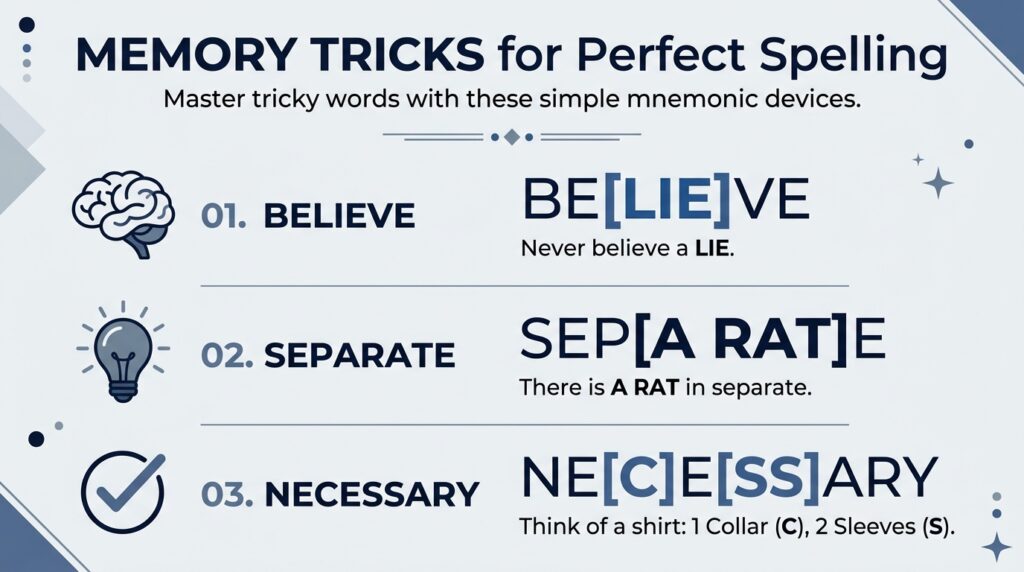
Rules are useful. But tricks make them stick. Try these simple methods.
Think About the Pronunciation
Say the word aloud: “OF-erd.” The strong sound is at the start. The end is light. A light ending does not need a double letter.
Compare It to “Opened”
“Opened” and “offered” follow the same pattern. Both have the stress on the first syllable. Both add “-ed” with no extra letter. You would never write “openned.” So do not write “offerred.”
Visual Memory Method
Picture the word in your mind: O-F-F-E-R-E-D. Notice that the double letter is already in the F’s. The word already has one pair. It does not need a second pair at the R. Think: “Offered has its double on the F, not the R.”
Use Repetition
Write the correct word five times. Then use it in three short sentences. Do this for a few days. Repetition builds muscle memory. Soon the right spelling will feel natural.
Here is a quick summary of the tricks:
| Trick | How It Helps |
| Say it aloud | Shows the weak ending |
| Compare to “opened” | Gives a similar pattern |
| Picture the double F | Reminds you the pair is already used |
| Practice writing | Builds long-term memory |
Offered in Professional Writing
Clear writing is a mark of a good professional. Using “offered” correctly shows attention to detail. It matters in documents that people read closely.
Two places where this word appears often are resumes and emails.
Resume Example
Resumes use past tense verbs to show achievements. “Offered” can fit in many lines. Here are a few good examples.
- Offering customer support solutions that improved satisfaction scores.
- Offered training sessions to new staff members.
- Offered creative ideas that increased monthly sales.
Always proofread your resume twice. One spelling error can hurt your chances.
Email Example
Here is a short sample email using the word.
Subject: Follow-Up on Our Meeting
Dear Sarah,
Thank you for your time yesterday. As discussed, we offered a flexible payment plan for your first order. Please let me know if you would like to move forward.
Best regards, Daniel
The message is short, polite, and clear. The word “offered” is spelled correctly.
Offered in Academic Writing
Academic writing needs precise language. Students and researchers use “offered” to describe courses, studies, ideas, and results. Correct spelling supports your credibility. Teachers and reviewers often mark spelling errors.
Academic Example
Here are a few lines that show academic use.
- The study offered new evidence about sleep and memory.
- The department offered three elective courses this semester.
- The author offered a different view of the historical event.
- The report offered clear steps for improving learning outcomes.
In essays, keep your sentences simple. Use “offered” when you want to show that someone presented an idea or option.
Offered in Digital Marketing

Online content lives and dies by trust. Marketers use “offered” in product pages, ads, emails, and blog posts. The word often appears with deals, discounts, and services. So it must be right.
Why Correct Spelling Helps
Correct spelling improves how readers see your brand. It also helps people find your content. Here is what clean writing does for you:
- It builds trust with new visitors.
- It makes your brand look professional.
- It keeps readers on the page longer.
- It reduces the chance of lost sales.
Search engines prioritize quality content. Obvious spelling mistakes can reduce perceived quality.
Search engines try to show helpful, reliable pages. Spelling is one small signal of quality. A page full of errors may look less trustworthy to both readers and algorithms. It will not always cause a drop in rank. But it can weaken the overall impression.
Good content with clean spelling has a better chance to earn trust and clicks.
Example
Compare these two ad lines:
- Weak: “We offerred free delivery on all orders.”
- Strong: “We offered free delivery on all orders.”
The second line looks clean and trustworthy. Shoppers are more likely to click it and buy.
Case Study: How a Small Spelling Error Hurt Credibility
Consider a small online store. The owner launched a big sale. The main banner said, “We offerred 50 percent off for the first week.” The team did not notice the typo.
Visitors saw the banner right away. Some left comments pointing out the error. A few said the shop felt “unprofessional.” Others hesitated to share their payment details. The owner later said sales were lower than expected.
After fixing the banner, trust slowly returned. The owner then added a simple proofreading step before every launch.
The lesson is clear:
- Small errors are noticed fast.
- Public mistakes spread quickly online.
- A short review can prevent a costly problem.
One extra letter did not break the store. But it did harm the brand’s image at a key moment.
Why English Spelling Confuses So Many People
English borrows words from many languages. French, Latin, German, and others all shaped it. Each source brought its own spelling habits. That is why English has so many exceptions.
On top of that, English spelling does not always match sound. Letters can be silent. Sounds can be written in many ways. Rules often have exceptions.
Here are a few reasons for the confusion:
- Many rules depend on stress, which is hard to hear at first.
- Similar words follow different patterns.
- Fast typing hides small errors.
- Learners often rely on one rule for every word.
The good news is that you can learn the main patterns. The stress rule is one of the most useful. With a bit of practice, spelling becomes much easier.
Quick Grammar Breakdown of “Offered”
Let’s break the word into simple steps. This shows exactly how “offered” is formed.
Base Verb
The base verb is “offer.” It means to present or give something. This is the form you use for the present tense: “I offer,” “you offer,” “they offer.”
Add “-ed”
To make the past tense, add “-ed.” So “offer” becomes “offered.” This form works for both the simple past and the past participle.
- Simple past: She offered help.
- Past participle: She has offered help.
Why No Double “R”?
Because the stress is on the first syllable. The rule says to double the last letter only when the stress is at the end. “Offer” is stressed at the start. So the R stays single.
Here is the full process in a small table.
| Step | Form |
| Base verb | offer |
| Check the stress | OF-fer (first syllable) |
| Double the R? | No |
| Add “-ed” | offered |
Common Mistakes Related to “Offered”
People search for this word in many ways. Below are the most common queries, with short and clear answers.
Offerred or Offered
“Offered” is correct. “Offerred” is wrong. Always use one R before “-ed.”
Spell Offer
The word is spelled O-F-F-E-R. It has two F’s and one R.
How Do You Spell Offered
The spelling is O-F-F-E-R-E-D. That is seven letters in total.
How to Spell Offered
Spell “offer” first, then add “-ed.” Do not double the R.
Oferred
“Oferred” is also wrong. It is missing one F. The correct word has two F’s.
Offered Synonym
Common synonyms include:
- Presented
- Proposed
- Provided
- Extended
- Granted
- Suggested
- Tendered
Offerred or Offered UK
British English also uses “offered.” There is no UK spelling with two R’s.
Offered or Offerred Examples
Correct: “The hotel offered a free breakfast.” Wrong: “The hotel offerred a free breakfast.”
Offered or Offerred in English
Standard English accepts only “offered.” The double R form is an error.
Offered or Offerred Pronunciation
“Offered” sounds like “OF-erd.” The sound is the same for both spellings, which is why people confuse them in writing.
Offered or Offerred Synonym
Both are not equal. Only “offered” is a real word, so only it has synonyms like “presented” or “provided.”
Offered or Offerred Meaning
“Offered” means presented or given for someone to accept. “Offerred” has no meaning because it is a misspelling.
Offered in a Sentence
“The company offered her a new role, and she accepted it happily.”
Frequently Asked Questions
Is it offered or offerred?
“Offered” is the correct spelling. “Offerred” is always a mistake.
How do you spell offers?
It is spelled O-F-F-E-R-E-D. It has two F’s and one R.
Why is it not spelled with two R’s?
The stress is on the first syllable of “offer.” The final letter only doubles when the stress is on the last syllable.
What is the past tense of offer?
The past tense of “offer” is “offered.” It is also the past participle.
Is offerred correct in British English?
No. British English also uses “offered.” There is no UK version with a double R.
How do you pronounce offered?
It is pronounced “OF-erd.” The stress is on the first syllable.
What is a synonym for offered?
Good synonyms include “presented,” “proposed,” “provided,” and “extended.”
Final Thoughts
“Offered” is the only correct spelling. The word has a single R because the stress falls on the first syllable. Words like “preferred” and “referred” double the R because their stress falls at the end. Once you know this, the confusion goes away.
Use the tricks in this guide to lock it in. Say the word aloud, compare it to “opened,” and picture the double F. Proofread your work before you send it. Clean spelling builds trust in emails, resumes, essays, and online content.

Reyansh is a passionate English language and grammar writer who enjoys making grammar, spelling, vocabulary, and writing concepts simple and easy to understand. With a focus on clear explanations and practical examples, Reyansh creates helpful content for students, writers, and everyday English learners. His goal is to make learning English more enjoyable, useful, and accessible to everyone.