Many people stop and wonder about this word. Is it “bearable” or “bareable”? The answer is simple. Only one spelling is correct in standard English. This guide explains which one it is, why the confusion happens, and how to remember it for good.
You will also find clear examples, handy tables, and memory tricks. Read on to write this word with confidence.
Bearable vs Bareable: The Quick Difference

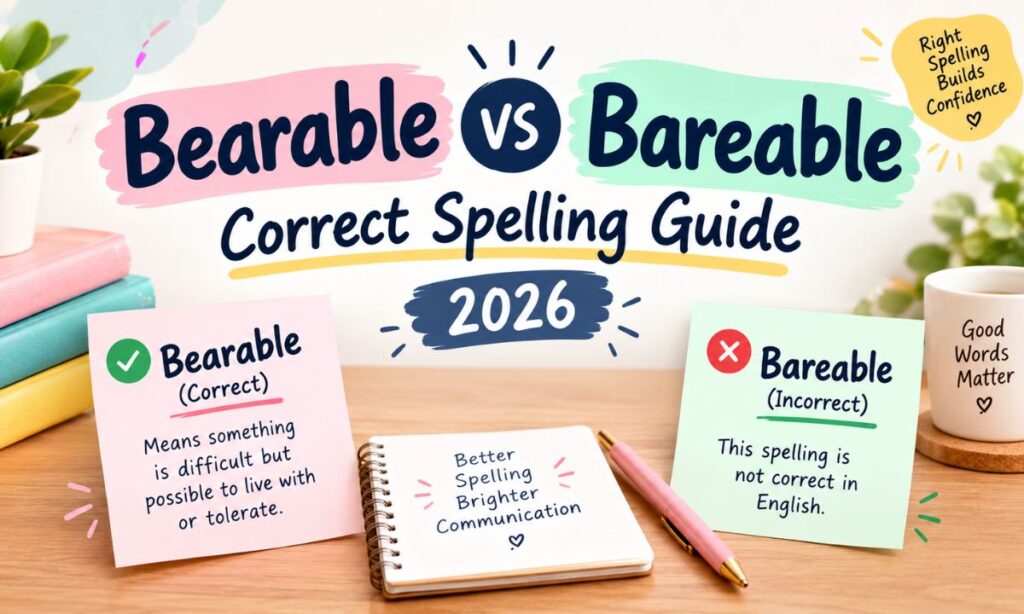
The correct spelling is bearable. It comes from the verb “bear,” which means to put up with something. “Bareable” is not a standard English word. It is a common spelling mistake.
Here is a quick look at the difference:
| Spelling | Correct? | Meaning |
| Bearable | Yes | Possible to put up with or endure |
| Bareable | No | A misspelling of bearable |
If you want a safe rule, use “bearable” every time. You will never go wrong.
What Does Bearable Mean?
Bearable describes something unpleasant that you can still handle. It might be pain, heat, noise, or a hard situation. It is not great, but it is not too much either.
Think of it as the middle ground. Something that is bearable is not easy. It is also not impossible.
Definition of Bearable
Bearable is an adjective. It means “able to be endured or tolerated.” The word is built from “bear” plus the ending “-able.”
Simple examples of the idea:
- A headache that is dull but manageable
- A long meeting that is boring but not painful
- Hot weather that is uncomfortable but safe
How Bearable Is Used in Sentences
You can place “bearable” before a noun or after a linking verb. Both ways are correct.
- Before a noun: “It was a bearable level of noise.”
- After a verb: “The pain was bearable.”
It also works with words like “more,” “less,” and “barely.” These words change how strong the feeling is.
Examples of Bearable in Everyday Writing
Here are some clear sentences you can use as a guide:
- The summer heat was bearable in the shade.
- Her new schedule made work more bearable.
- The soup was too spicy, but still bearable.
- A kind friend can make hard days bearable.
- The cold was bearable with a warm coat.
Is Bareable a Real Word?
No. “Bareable” is not a real English word. It is not part of standard spelling. If you use it in school, work, or published writing, it will count as an error.
Still, people type it all the time. Let us look at why.
Why Many People Search for Bareable
People often type words the way they sound. “Bearable” and “bareable” sound the same. So some writers guess the spelling and search to check it.
That is why you see so many searches for this word. Most of these people simply want to confirm the right spelling. That is a smart habit.
What Dictionaries Say About Bareable
Major dictionaries do not list “bareable” as an entry. They list only “bearable.” If you look up the wrong spelling, many tools will suggest the correct one.
This is a strong sign. When trusted dictionaries ignore a word, it is not accepted in standard English.
Rare Historical Uses
You may find odd spellings in very old texts. Spelling was not fixed in the past. Writers often spelled words in different ways.
But those rare cases do not matter today. Modern English uses one spelling, and that is “bearable.” Do not rely on old texts for current writing.
Why People Confuse Bearable and Bareable
The mix-up is very common. It is not a sign of poor writing. English has many tricky spelling patterns, and this is one of them.
Let us look at the main reasons.
Similar Pronunciation
“Bear” and “bare” are homophones. They sound the same but have different spellings and meanings. When you say “bearable” out loud, the first part sounds like “bare.”
Because the sound gives no clue, writers must rely on memory. That is where errors start.
The Influence of the Word “Bare”
“Bare” is a very common word. It means uncovered or empty. People see it often, so their brain may pick it first.
For example, you may know phrases like “bare feet” or “bare minimum.” Your mind may link the sound to “bare” without thinking.
Common English Spelling Traps
English has many pairs like this. Here are a few more:
| Pair | Quick Note |
| their / there | Same sound, different meaning |
| to / too | Same sound, different use |
| break / brake | Same sound, different meaning |
| bear / bare | Same sound, different meaning |
Once you know the root of each word, these traps become easier to avoid.
Understanding the Root Words

The best way to fix this mistake is to know the base word. “Bearable” comes from “bear.” It does not come from “bare.” Let us look at both words.
The Meaning of “Bear”
“Bear” has a few common meanings:
- To carry something
- To put up with something
- To give birth to
- A large animal
For “bearable,” the meaning “to put up with” is the key. If you can bear something, it is bearable.
The Meaning of “Bare”
“Bare” means uncovered, plain, or empty. It can also mean the smallest amount.
- Bare walls
- Bare hands
- The bare facts
None of these ideas fit with “bearable.” That is a good clue that “bare” is the wrong root.
How Root Meanings Prevent Mistakes
Ask yourself one question: “Does this word mean to endure?” If yes, think of “bear.” Then add “-able.”
This small step takes only a second. It will protect you from the mistake every time.
See More : Tie vs Tye: Correct Spelling & Meaning (2026)
Bearable in Different Contexts
The word “bearable” fits many parts of life. It is useful because it describes something that is hard but not too hard.
Medical Context

In health settings, people use “bearable” to talk about pain or discomfort. A person may say, “The pain is bearable now.” This means it has become easier to handle.
Doctors often ask patients to rate pain. A bearable level is one the patient can cope with. Always follow a doctor’s advice for real health concerns.
Emotional Context
Emotions can feel heavy. “Bearable” helps describe grief, stress, or worry that you can still cope with.
- “Talking to a friend made the sadness more bearable.”
- “Time made the loss bearable.”
It shows hope without ignoring the pain.
Workplace Context
At work, people use “bearable” for long hours, hard tasks, or tough bosses.
- “A good team makes a busy week bearable.”
- “The commute is long, but bearable.”
It is a polite way to say something is not perfect, but fine.
Environmental Context
Weather and surroundings are common topics. Heat, cold, and noise are often called bearable or unbearable.
- “The humidity was bearable by evening.”
- “The city noise is bearable with the windows shut.”
Common Phrases Using Bearable
Some phrases appear again and again. Learning them will help you sound natural.
Make Life Bearable
This phrase means to make life easier to handle during a hard time. “Small joys make life bearable.”
More Bearable
Use this when something improves but is not fully good. “The room felt more bearable after the fan came on.”
Barely Bearable
This means something is almost too much. “The heat was barely bearable.” It shows you are close to your limit.
Become Bearable
Use this when a hard thing slowly gets easier. “The pain became bearable after a few days.”
Keep Something Bearable
This means to hold something at a level you can manage. “She kept her workload bearable by planning ahead.”
Bearable Synonyms and Alternatives
Using the same word too often can feel dull. Here are some other words you can use.
- Tolerable
- Endurable
- Manageable
- Acceptable
- Passable
- Sufferable
Each word has a slightly different feel, so choose with care.
Example Comparisons
- “The noise was bearable.” (You can handle it.)
- “The noise was tolerable.” (You can put up with it.)
- “The noise was manageable.” (You can control or cope with it.)
Bearable vs Similar Words
These words are close in meaning. Still, small differences exist.
| Word | Best Used For | Example |
| Bearable | Pain or hardship you can endure | The cold was bearable. |
| Tolerable | Things you allow or accept | The price was tolerable. |
| Endurable | Long or lasting hardship | The journey was endurable. |
| Manageable | Tasks you can handle | The workload is manageable. |
| Acceptable | Things that meet a standard | The result was acceptable. |
Bearable vs Tolerable
Both words are close. “Bearable” often fits pain or hardship. “Tolerable” often fits things you accept, like a rule or a cost.
Bearable vs Endurable
“Endurable” is more formal and less common. It stresses lasting through something long. “Bearable” is simpler and more natural in daily speech.
Bearable vs Manageable
“Manageable” is about control. You can handle a task or a size of work. “Bearable” is about feeling. You can stand the discomfort.
Bearable vs Acceptable
“Acceptable” means good enough. It has nothing to do with pain. “Bearable” has to do with how hard something feels.
Examples of Incorrect and Correct Usage
| Incorrect | Correct |
| The pain was bareable. | The pain was bearable. |
| It made life more bareable. | It made life more bearable. |
| The heat is barely bareable. | The heat is barely bearable. |
Notice that only the spelling changes. The meaning stays the same.
Memory Tricks to Remember the Correct Spelling

A few simple tricks can lock in the right spelling. Pick the one that works best for you.
The “Bear the Pain” Trick
Say this line in your head: “I can bear the pain, so it is bearable.” The word “bear” sits right inside “bearable.” Both have the letters E and A together.
Word Association Method
Link “bearable” with other “bear” words you know:
- Bear a burden
- Bear the cost
- Bear with me
All of these mean to carry or put up with something. “Bearable” belongs to this family.
Visual Learning Technique
Picture a strong bear carrying a heavy load. The bear stands for strength and endurance. When you see “bearable,” imagine that bear. It helps you remember the “ea” spelling.
Common Grammar and Spelling Mistakes Related to Bearable
Other word pairs cause trouble too. Let us look at the most common ones.
Bear vs Bare
“Bear” means to carry or endure. “Bare” means uncovered or empty. Use “bear” for “bearable.”
Borne vs Born
“Borne” is the past participle of “bear” when it means to carry or endure. “Born” is used for birth.
- “She has borne the pain well.”
- “He was born in May.”
Barely vs Bearably
“Barely” means only just. It comes from “bare.” “Bearably” means in a way that can be endured. It comes from “bear.”
- “He barely made it.”
- “The room was bearably warm.”
Bearing vs Baring
“Bearing” comes from “bear.” “Baring” comes from “bare,” meaning to uncover.
- “She is bearing the cost.”
- “He is baring his teeth.”
Bare-able
“Bare-able” with a hyphen is also incorrect. Adding a hyphen does not make it a real word. The right form is “bearable,” with no hyphen and no space.
Bare able
“Bare able” as two words is also wrong. It may look like “bare” plus “able,” but that is not how the word is built. Write it as one word: “bearable.”
Bearable or Bareable
If you must choose, pick “bearable.” It is the only correct form in standard English. Trusted dictionaries, style guides, and writers all agree.
Bareable or Bearable
The order of the words does not change the answer. Whether you see “bareable or bearable” or the other way round, the correct spelling is still “bearable.”
Bearable or Bareable UK
British and American English use the same spelling here. It is “bearable” in both. There is no UK version of “bareable.”
Some British words differ from American ones, such as “colour” and “color.” But this word is not one of them.
Bearable App
Bearable is also the name of a popular health tracking app. People use it to log mood, symptoms, sleep, and daily habits. It helps them spot patterns over time.
Because the app uses the name “Bearable,” many people search for it online. The app name follows the correct spelling too. Always check your app store for the official listing.
Bearable vs Bareable App
Some users type “bareable app” by mistake when they look for the tracker. The correct name is “Bearable.” If you search with the wrong spelling, search engines will often fix it for you. Still, using the right spelling gets you results faster.
Bearable Meaning
The meaning of bearable is simple. It describes something that you can put up with, even if it is not pleasant. It sits between easy and unbearable.
You can use it for pain, weather, stress, or any hard situation.
Bearable vs Bareable Meaning
Only “bearable” has a real meaning. “Bareable” has no meaning in standard English because it is not a word. When people write “bareable,” they usually mean “bearable.”
| Term | Meaning |
| Bearable | Able to be endured or tolerated |
| Bareable | No meaning; a spelling mistake |
Frequently Asked Questions
Is it bearable or bareable?
The correct spelling is “bearable.” “Bareable” is a misspelling and is not a real English word.
What does bearable mean?
Bearable means able to be endured or tolerated. It describes something unpleasant that you can still handle.
Is bareable a word in the dictionary?
No. Standard dictionaries do not list “bareable.” They list only “bearable.”
Is bearable spelled differently in UK English?
No. UK and US English both use “bearable.” The spelling is the same everywhere.
What is the root word of bearable?
The root word is “bear,” meaning to put up with or endure. The ending “-able” means capable of being.
What is the Bearable app used for?
The Bearable app is a health tracker. It helps people log mood, symptoms, sleep, and habits to find patterns.
How can I remember the correct spelling of bearable?
Think “bear the pain.” The word “bear” sits inside “bearable,” so use the “ea” spelling every time.
Final Thoughts
The right spelling is always “bearable.” It comes from the verb “bear,” which means to endure. “Bareable” is only a common typo caused by the matching sound of “bear” and “bare.” Hyphenated or split versions, like “bare-able” and “bare able,” are wrong as well.
To remember it, think of a bear carrying a heavy load. Use the root word trick and the phrase “bear the pain.” With a little practice, the correct spelling will feel natural. You can now write the word with full confidence in any context.

Reyansh is a passionate English language and grammar writer who enjoys making grammar, spelling, vocabulary, and writing concepts simple and easy to understand. With a focus on clear explanations and practical examples, Reyansh creates helpful content for students, writers, and everyday English learners. His goal is to make learning English more enjoyable, useful, and accessible to everyone.