

Kinesiology is the study of human movement. Kinesthesiology is a rare, older variant of the same word. Many people see both spellings and wonder if they mean different things. This guide explains the difference in plain words.
You will learn what each term means, where it is used, and which one to choose. You will also see careers, myths, and a real-life example.
Kinesthesiology vs Kinesiology at a Glance

Here is a quick view of both terms side by side.
| Feature | Kinesiology | Kinesthesiology |
| Meaning | Study of human movement | Rare variant, often linked to the sense of movement |
| Usage | Very common | Very rare |
| Used in | Universities, healthcare, sports | Older texts, some alternative health groups |
| Accepted in academia | Yes | No |
| Best for writing | Yes | Avoid |
Quick Answer
Kinesiology is the correct and standard term. Kinesthesiology is a rare spelling that most experts do not use. If you are writing a paper, a resume, or a website, choose kinesiology.
What Is Kinesiology?
Kinesiology is the scientific study of how the body moves. It looks at muscles, bones, joints, and the nervous system. It also studies how the mind affects movement.
The word comes from Greek. “Kinesis” means movement. “Logia” means study. So kinesiology simply means the study of movement.
Why Kinesiology Matters
Movement is part of daily life. Walking, lifting, and sitting all depend on how the body works. Kinesiology helps us understand these actions and improve them.
It matters in many ways:
- It helps prevent injuries.
- It speeds up recovery after surgery or accidents.
- It improves sports performance.
- It supports healthy aging.
- It guides better workplace design.
Main Areas of Kinesiology

Kinesiology has several branches. Each one looks at movement from a different angle.
Exercise Physiology
This area studies how the body reacts to exercise. It covers heart rate, breathing, muscle energy, and fitness. Exercise physiologists help people build safe and effective workout plans.
Biomechanics
Biomechanics applies physics to the human body. It studies forces, motion, and posture. It helps improve technique and lower injury risk.
Motor Learning
Motor learning explains how people learn new physical skills. Think of a child learning to ride a bike. This field studies practice, feedback, and skill memory.
Sports Psychology
Sports psychology looks at the mind of the athlete. It covers focus, stress, motivation, and confidence. A strong mindset often leads to better results.
Rehabilitation Science
This branch focuses on recovery. It helps people regain strength and movement after injury or illness. It works closely with doctors and therapists.
Where the Term Kinesiology Is Commonly Used
Kinesiology appears in many places. It is the standard term across the world.
Universities
Most colleges offer degrees called Kinesiology or Human Kinesiology. Departments, journals, and research papers all use this spelling.
Healthcare
Hospitals and clinics use kinesiology in rehab and therapy programs. Professionals use it when they talk about movement problems and recovery plans.
Sports Performance
Teams and gyms use kinesiology to train athletes. Coaches rely on it to improve speed, strength, and safety.
What Is Kinesthesiology?
Kinesthesiology is a rare term. It mixes “kinesthesia” with the “-ology” ending. Kinesthesia is the body’s sense of its own movement and position. So the word suggests a study of that sense.
In practice, most people who write it simply mean kinesiology. It is not a separate science. It is not widely recognized in schools or journals.
Historical Background
The word appeared in some older writings. Early authors used different spellings before the standard term settled. Kinesthesiology was one of these variants.
Over time, kinesiology became the accepted form. The other spelling faded from serious use.
Current Usage of Kinesthesiology
Today, kinesthesiology is uncommon. You may still find it in a few places. These places are listed below.
Alternative Health Practices
Some alternative health groups use the word. They often mix it with energy or muscle testing ideas. This use is not the same as academic kinesiology.
Older Publications
Old books and articles may show this spelling. It reflects past habits of writing, not current science.
Regional Preferences
A few writers in some regions prefer it out of habit. Still, it is not the standard form anywhere in academia.
Are Kinesthesiology and Kinesiology the Same Thing?
Mostly, yes. In everyday use, the two words point to the same idea. But only one is correct and widely accepted.
The Short Answer
Kinesthesiology is a rare variant of kinesiology. They are not two different sciences. Always use kinesiology in formal work.
Similarities
Both terms share a lot:
- Both come from Greek roots.
- Both relate to movement.
- Both are connected to the human body.
- Both can appear in health talks.
See MOre : IBVS Meaning in Text: Full Guide & Uses (2026)
Differences
| Point | Kinesiology | Kinesthesiology |
| Recognition | Global standard | Rarely recognized |
| Degree programs | Yes | No |
| Research journals | Common | Almost none |
| Professional use | Widely accepted | Not preferred |
| Risk of confusion | Low | High |
Why Does the Spelling Difference Exist?
The difference comes from language habits. People blended two related words. One word became standard. The other stayed rare.
Greek Origins
Both words start from the Greek “kinesis,” meaning movement. The ending “-logia” means study. This gives kinesiology its clear meaning.
The Influence of Kinesthesia
Kinesthesia is a real word. It means the sense of body movement. Because it is common in science, some people added “-ology” to it. That created kinesthesiology.
Academic Standardization
Universities and journals chose kinesiology as the official form. Standard spelling keeps research clear. Over time, the shorter word won.
Kinesiology in Education
Kinesiology is a popular degree. It prepares students for health, fitness, and sports careers. Many also use it as a step toward medical or therapy school.
Common Subjects Studied
Students usually take these courses:
- Human anatomy
- Physiology
- Biomechanics
- Exercise science
- Motor control and learning
- Nutrition
- Sports psychology
- Research methods
Practical Training
Hands-on work is a big part of the degree. Students practice in labs, gyms, clinics, and sports teams. They learn to test fitness, assess posture, and design programs. Internships give real experience with real clients.
Career Opportunities in Kinesiology

A kinesiology degree opens many doors. Some jobs need extra training or licenses.
Exercise Physiologist
They design exercise plans for people with health conditions. They work in hospitals, clinics, and wellness centers.
Athletic Trainer
They prevent and treat sports injuries. They often work with schools, teams, and clubs.
Physical Therapist Pathway
Many graduates go on to physical therapy school. This path needs a doctoral degree and a license. It leads to helping patients recover movement.
Strength and Conditioning Coach
They train athletes to become stronger and faster. They plan workouts and track progress.
Sports Scientist
They study performance data. They use tools like sensors and video to improve results.
Wellness Specialist
They guide people toward healthier habits. They work in companies, gyms, and community programs.
| Career | Work Setting | Extra Training |
| Exercise Physiologist | Clinics, hospitals | Often certification |
| Athletic Trainer | Schools, teams | Certification required |
| Physical Therapist | Hospitals, clinics | Doctoral degree and license |
| Strength Coach | Gyms, sports teams | Certification helpful |
| Sports Scientist | Labs, teams | Advanced degree often helps |
| Wellness Specialist | Companies, communities | Varies |
Skills Developed Through Kinesiology
Students gain more than science knowledge. They build skills useful in many jobs.
Technical Skills
- Reading movement and posture
- Using fitness testing tools
- Understanding anatomy
- Analyzing data
Communication Skills
Kinesiology graduates explain complex ideas in simple words. They listen to clients and give clear advice. They also write reports and work well in teams.
Problem-Solving Skills
They learn to spot the cause of a movement problem. Then they design a plan to fix it. They adjust the plan when progress slows.
Kinesiology vs Physical Therapy
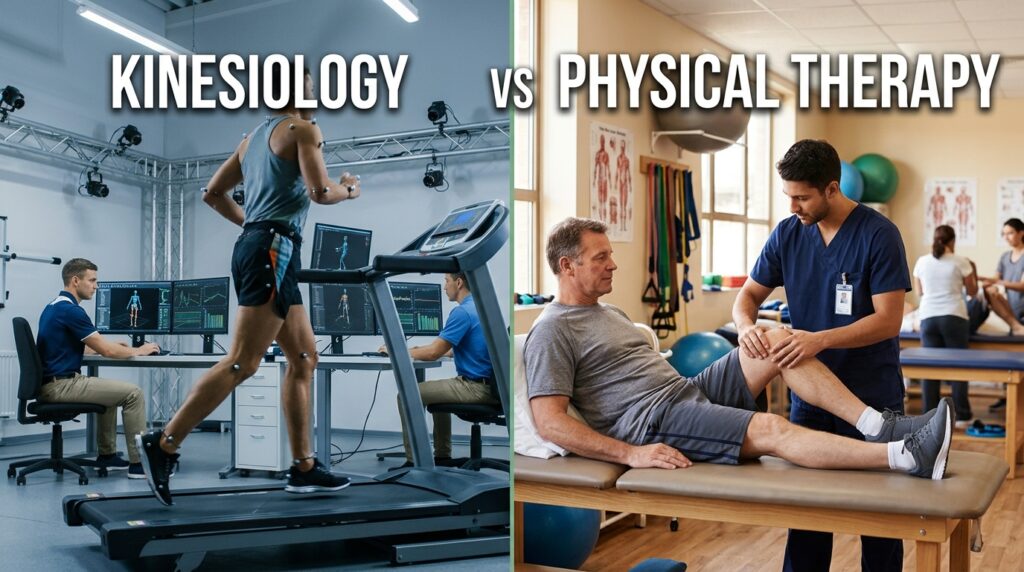
Kinesiology is a broad field of study. Physical therapy is a licensed healthcare profession. Physical therapists diagnose and treat movement problems in patients.
Kinesiology often serves as the base for this career. A student studies kinesiology first. Then they enter a physical therapy program.
Kinesiology vs Exercise Science
These two names often overlap. Some schools use them for the same degree. Others treat them a bit differently.
Kinesiology
Kinesiology covers the whole study of movement. It includes health, behavior, learning, and rehab.
Exercise Science
Exercise science focuses more on how the body responds to exercise. It leans toward fitness, training, and performance.
Kinesiology vs Sports Medicine
Sports medicine is a medical area. It treats injuries and conditions linked to sport and exercise. Doctors, therapists, and trainers work in it.
Kinesiology is the science behind movement. Sports medicine uses that science to care for patients. One is a field of study. The other is a field of care.
Kinesiology vs Biomechanics
Biomechanics is one part of kinesiology. It is narrower in focus.
Biomechanics Focuses On
- Forces acting on the body
- Joint motion
- Movement efficiency
- Equipment design
Kinesiology Covers
- Biomechanics
- Exercise physiology
- Motor learning
- Sports psychology
- Rehabilitation
Which Term Should You Use?
Use kinesiology almost every time. It is clear, correct, and trusted.
For Academic Writing
Always write kinesiology. Teachers, editors, and journals expect it. The other spelling may look like a mistake.
For Professional Communication
Use kinesiology on resumes, websites, and emails. It builds trust with clients and employers.
For General Conversations
Kinesiology is also best in daily talk. People will understand you right away.
Common Misconceptions About Kinesiology and Kinesthesiology
Several myths cause confusion. Let us clear them up.
Myth: They Are Completely Different Fields
They are not. Kinesthesiology is mostly a rare spelling of the same idea.
Myth: Kinesthesiology Is Always Wrong
It is not a fake word. It has appeared in older texts and some groups. But it is not the standard form, so avoid it in formal work.
Myth: Kinesiology Only Applies to Athletes
Kinesiology helps everyone. It supports office workers, seniors, children, and patients.
Myth: Kinesiology Is Just Fitness Training
Fitness is one small part. Kinesiology also covers rehab, learning, research, and mental skills.
Real-World Example: How Kinesiology Improves Recovery
Imagine a man who injures his knee while playing football. After surgery, he feels weak and afraid to move. A kinesiology-trained specialist steps in.
First, the specialist checks how he walks. Then they build a gentle exercise plan. They track his progress each week. They also teach him safe movement habits.
After a few months, his strength returns. His pain drops. He goes back to sport with confidence. This shows how kinesiology blends science and care.
Kinesiology Pronunciation
Kinesiology is pronounced kih-nee-see-OL-uh-jee. Say it slowly in parts: kih, nee, see, ol, uh, jee. The stress falls on the “ol” sound.
Kinesthesiologist
A kinesthesiologist is a rare term. It usually refers to a kinesiologist, meaning a person who studies or works with human movement. The standard job title is kinesiologist.
In most places, this title is used for professionals in fitness, rehab, and movement science. If you want to describe yourself in this field, use a kinesiologist.
Frequently Asked Questions
What is the difference between kinesiology and kinesthesiology?
Kinesiology is the standard term for the study of human movement. Kinesthesiology is a rare variant that is not widely accepted.
Is kinesthesiology a real word?
It appears in some older texts and alternative health circles. But it is not the standard academic term.
Which is the correct spelling, kinesiology or kinesthesiology?
Kinesiology is the correct spelling. Use it in all formal and professional writing.
What does kinesiology mean in simple words?
Kinesiology means the study of how the human body moves. It covers muscles, joints, exercise, and recovery.
What jobs can you get with a kinesiology degree?
You can become an exercise physiologist, athletic trainer, strength coach, sports scientist, or wellness specialist. Many also continue to attend physical therapy school.
Is kinesiology the same as physical therapy?
No. Kinesiology is a field of study. Physical therapy is a licensed healthcare profession.
How do you pronounce kinesiology?
It is pronounced kih-nee-see-OL-uh-jee, with stress on the “ol” sound.
Final Thoughts
Kinesiology and kinesthesiology point to the same basic idea, which is human movement. But kinesiology is the correct, standard, and trusted term. Kinesthesiology is rare and mostly found in older or informal sources.
If you study, write, or work in this field, stick with kinesiology. It keeps your message clear and professional. It also opens the door to many careers that help people move better and live healthier.

Reyansh is a passionate English language and grammar writer who enjoys making grammar, spelling, vocabulary, and writing concepts simple and easy to understand. With a focus on clear explanations and practical examples, Reyansh creates helpful content for students, writers, and everyday English learners. His goal is to make learning English more enjoyable, useful, and accessible to everyone.